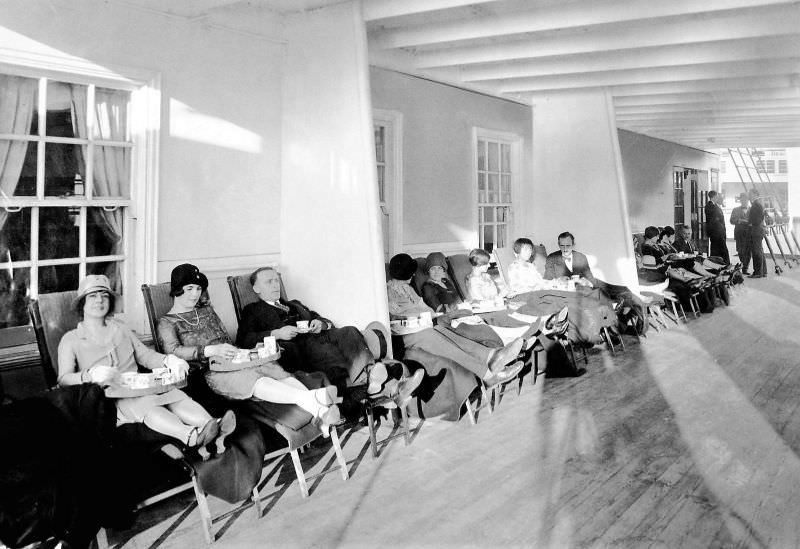
Afternoon light pours along Aquitania’s 2nd Class Promenade Deck as passengers settle into deck chairs with trays balanced on their laps, turning tea into a small daily ritual at sea. Cloche hats, dark coats, and neatly arranged cups suggest the easy formality of the mid-1920s, when even a modestly priced crossing promised a taste of ocean-liner elegance. The long run of windows and beams frames a sheltered corridor where conversation, reading, and people-watching could unfold between ports.
On this covered promenade, comfort is engineered as much as it is served: reclining chairs line the bulkhead, while the open side of the deck offers air and brightness without the full bite of wind. A few passengers lean back with the languor of a holiday, others sit upright as if the Atlantic were a public room with its own etiquette. Small details—folded blankets, clustered tables, and the rhythm of chairs repeating into the distance—convey how second class travel on Cunard’s great liner mixed practicality with pleasure.
Aquitania’s reputation in the 1920s and 1930s rested on precisely these experiences, where the voyage itself became part of the attraction on the Atlantic crossing. Scenes like this help explain why the ship remained so popular: not merely for getting from one shore to another, but for the carefully staged calm of promenades, service, and shared routines. For readers drawn to maritime history, ocean liner travel, and the social life of interwar voyages, this photo offers an intimate window onto how passengers spent their days at sea.