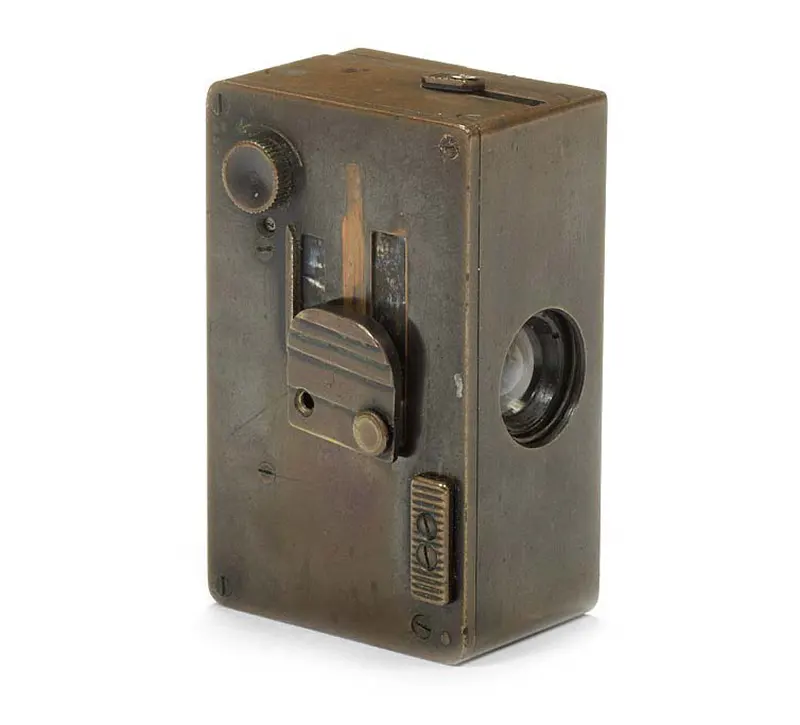
A squat, metal-bodied box with a side-mounted lens and a few purposeful controls, the “Mast Concealable camera” from 1950 looks more like a piece of field equipment than a consumer gadget. Its worn finish, sharp edges, and compact proportions suggest a tool built to be handled quickly and kept out of sight, with function taking priority over comfort or decoration. Even without a visible maker’s badge in the photo, the design language speaks clearly: discreet photography, engineered to work.
Closer inspection reveals practical details that hint at how it was operated—knurled dials for adjustment, a sliding mechanism on the front, and a sturdy casing meant to survive pockets, bags, or rough storage. The lens sits flush in a recessed opening, reducing snagging and protecting the glass, while the minimal external fittings keep the silhouette plain and easy to conceal. In an era when many cameras were styled for display, this one seems intended to disappear.
For readers interested in mid-century inventions and the history of surveillance technology, this 1950 concealable camera offers a fascinating snapshot of postwar design priorities: portability, durability, and unobtrusiveness. It also underscores how photographic innovation wasn’t only about sharper images or brighter lenses, but about new ways to carry and use a camera in everyday—or sensitive—situations. As an artifact, it bridges mechanical craft and the evolving culture of privacy, documentation, and covert observation.