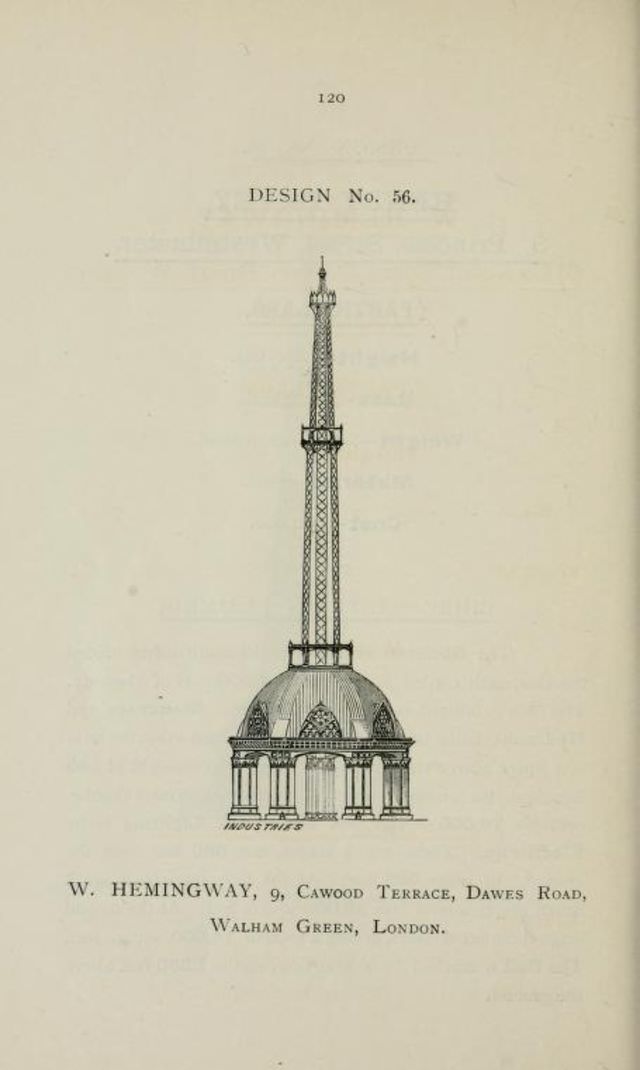
Ambition runs through these late‑Victorian “Great Tower for London” proposals, when inventors and designers reportedly sent in dozens of competitive schemes meant to rival the era’s newest feats of engineering. The plate reproduced here is labeled “DESIGN No. 56,” a reminder that this was not a single dream on paper but a crowded contest of ideas, each offering London its own landmark of iron, glass, and civic pride.
Here, a slender lattice shaft rises from an ornate domed base, mixing industrial structure with classical decoration in a way that feels distinctly 1890s. The drawing balances practicality and spectacle: a sturdy lower pavilion with arched openings and layered detailing, topped by a narrow tower that suggests viewing platforms and a dramatic skyline presence. Even in simple linework, the concept sells height, modernity, and the promise of panoramic London views.
At the bottom of the page, the credit line reads “W. HEMINGWAY, 9, Cawood Terrace, Dawes Road, Walham Green, London,” grounding this visionary project in a real address and a working designer’s identity. For anyone interested in Victorian inventions, London architecture history, or the broader story of unrealized monuments, this design sheet offers a fascinating window into how competition, publicity, and engineering imagination shaped the city’s aspirations.