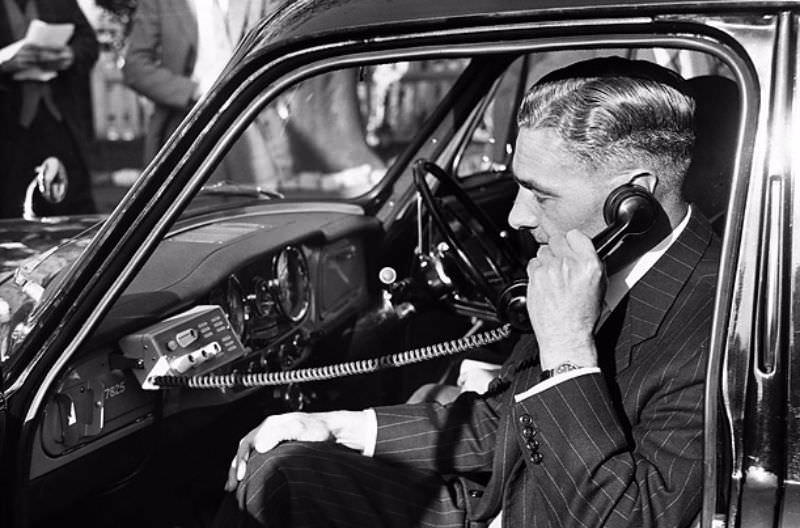
Leaning into the driver’s seat in a sharp suit, Reginald Blevins lifts a telephone-style handset to his ear, turning an ordinary car interior into a stage for a technological first. The coiled cord leads to a compact radio-telephone unit mounted near the dashboard, its dials and switches hinting at the engineering packed into this early mobile setup. In the blurred background, onlookers crowd close, underscoring that this is not a private moment but a public inauguration.
In 1959, the idea of making a call from a car still felt closer to science fiction than daily routine, and the UK’s first radio telephone service arrived as a symbol of modernity and ambition. Unlike the pocket devices that define today’s mobile communication, these pioneering systems were bulky, vehicle-bound, and tied to specialist networks, yet they promised something transformative: connection without the need for a fixed line. The photograph captures that threshold between the wired world and the wireless one, when mobility began to reshape expectations of speed, availability, and reach.
Collectors of invention history and radio technology will appreciate how much the scene reveals in small details—the handset design, the visible wiring, and the way the equipment integrates with the car’s controls. For readers searching for early mobile phone history in the UK, this image offers a concrete glimpse of the infrastructure and ceremony behind “first service” announcements, not just the headline. It’s a reminder that today’s effortless calls were built on decades of experimental hardware, public demonstrations, and bold steps like this one.