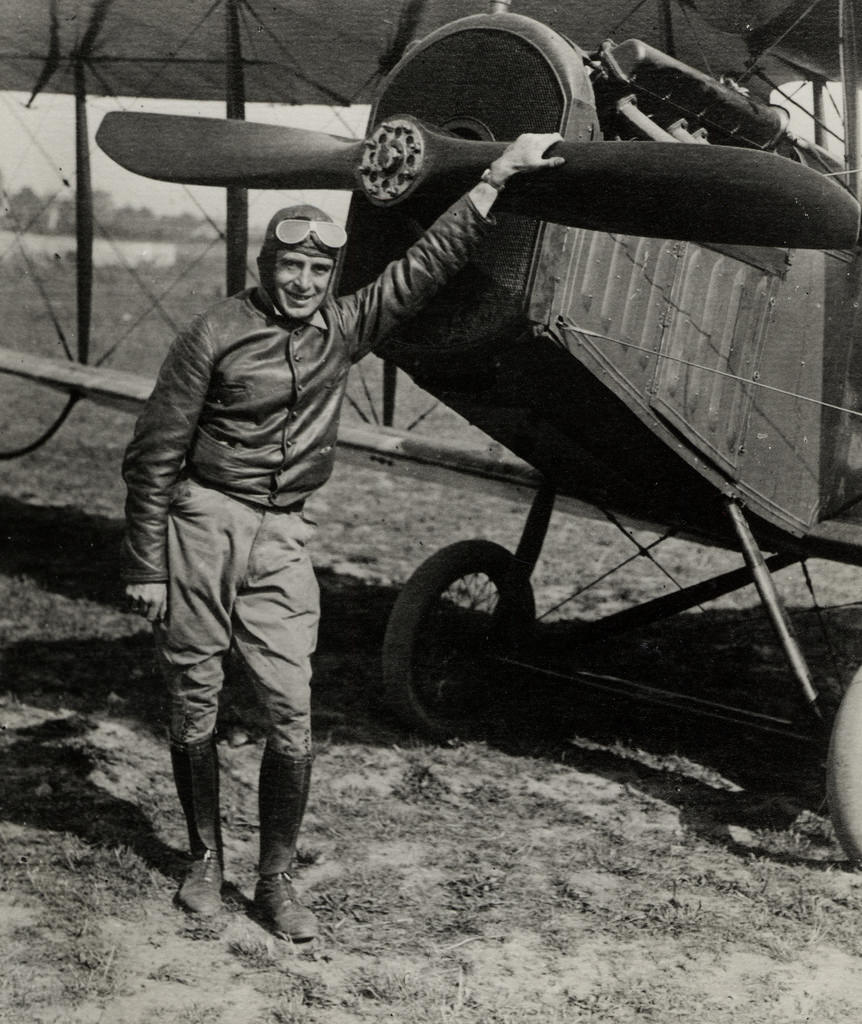
Leaning on the broad wooden propeller of a biplane, airmail pilot Eddie Gardner poses with an easy confidence that belies the risks of early flight. His leather jacket, lace-up boots, and snug flying cap with goggles speak to an era when warmth and visibility were survival tools as much as style. The open framework of wings and struts behind him turns the portrait into a close-up study of 1918 aviation in working clothes.
Attention naturally goes to the aircraft’s nose: a round engine cowling, exposed mechanics, and the simple landing gear planted in uneven ground. The propeller dominates the foreground, reminding us how much depended on a few spinning feet of wood and careful maintenance before every run. Even without route details, the scene evokes the gritty reality of pioneering airmail service—takeoffs from fields, constant vibration, and technology still in its bold, experimental youth.
Airmail in 1918 sat at the crossroads of invention and necessity, where pilots like Gardner helped prove airplanes could do more than thrill spectators or serve wartime needs. Each successful delivery nudged public trust forward and pushed aircraft design toward reliability, speed, and better navigation. For readers interested in early airmail history, pioneering pilots, and World War I–era aviation technology, this photograph offers a vivid, human-scale window into the beginnings of modern air transport.