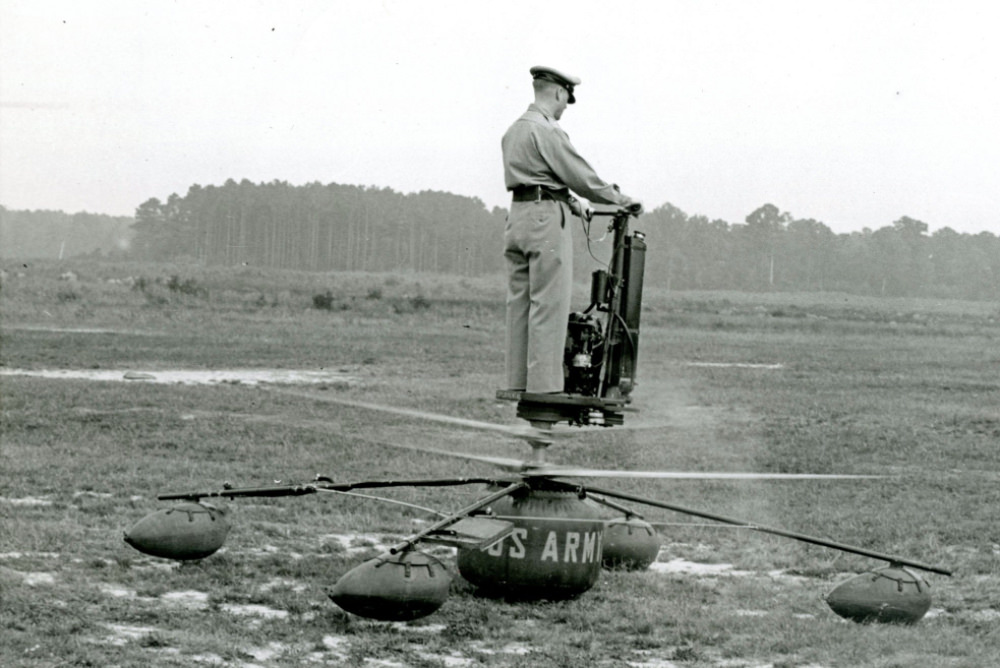
Balancing upright on a small platform above a spinning rotor, a uniformed test pilot appears to “stand” in flight rather than sit in a cockpit. The de Lackner HZ-1 Aerocycle was conceived as a one-man personal helicopter, a compact device meant to lift a single soldier quickly over rough ground, rivers, or obstacles. In the photo, the open-air design is unmistakable: minimal structure, handlebars for control, and little separating the operator from the machinery beneath.
Across the field, the craft’s simplicity reads like a postwar dream of portable aviation—part helicopter, part flying scooter—marked plainly with “U.S. ARMY” on the central body. The stabilizing floats and long, low rotor blades hint at the engineering compromises needed to keep such a tiny rotorcraft steady, while the pilot’s posture underscores how exposed and demanding the experience must have been. It’s an inventions-era snapshot of 1950s experimentation, when military planners and designers chased mobility with bold, sometimes risky prototypes.
Yet the Aerocycle’s story is also a cautionary tale about what happens when radical concepts meet real-world flight testing. Without the protective cabin, redundancy, and forgiving handling of larger helicopters, this personal helicopter proved difficult to control and ultimately unsuccessful, despite the promise suggested by its clean, utilitarian form. For readers interested in Cold War technology, experimental aircraft, and unusual military aviation projects, this image captures the moment optimism and practicality hovered dangerously close together.