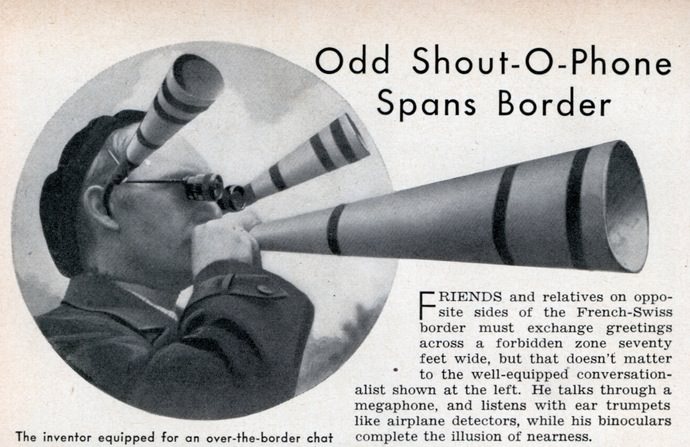
Odd Shout-O-Phone Spans Border—so reads the caption beside a striking 1940-era invention that looks equal parts playful and practical. A man in profile presses a flared speaking tube to his mouth while a matching set of trumpet-like horns points outward, turning ordinary conversation into something closer to a public address system. The exaggerated cones and bold stripes give the apparatus a carnival flair, yet the intent is serious: to carry a human voice farther than it would normally travel.
The printed text explains the problem it aimed to solve: friends and relatives separated by a border could exchange greetings across a “forbidden zone” said to be seventy feet wide. Instead of telephones and wires, the Shout-O-Phone relies on sheer acoustics—megaphones for speech and listening, paired with binoculars for visual connection. It’s a vivid reminder that communication history isn’t only about switches and circuits; it’s also about clever, low-tech workarounds made for the constraints of the moment.
Inventions like this sit at the crossroads of gadgetry, geography, and everyday longing, making the Shout-O-Phone a memorable entry in the story of early communication devices. For readers interested in 1940 inventions, vintage technology, and the human side of borderlands, the photo offers plenty to linger over: the improvisational engineering, the theatrical silhouette, and the simple hope that a conversation might still travel when people cannot. Whether it ever caught on is almost beside the point—the Shout-O-Phone embodies an era’s determination to be heard.