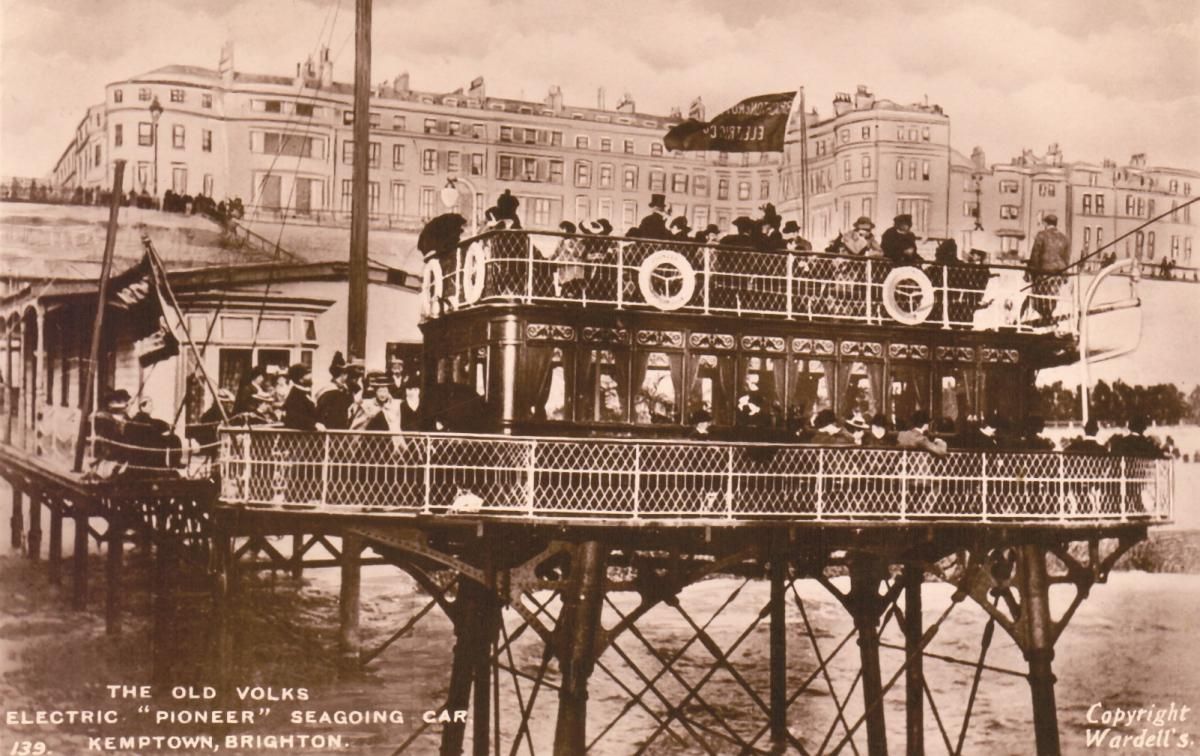
Crowds cluster along the railings of a two-level sea-going carriage, hats and coats packed shoulder to shoulder as if for a holiday outing rather than a railway ride. The oddity is the setting: not tracks on land, but a vehicle poised over the water on spindly supports, with waves rolling beneath and a bright, open promenade skyline behind. Even in a still image, the scene has motion—wind tugging at flags, people leaning for a better view, and the sea itself forming the “right-of-way.”
Known as Brighton’s “Daddy Long-Legs” railway, the title hints at why it became legend: an electric train built to stride across the shallows like an insect, linking the seaside with an engineering solution as playful as it was ambitious. The photo’s details—lifebuoy rings fixed to the upper deck, latticework supports, and the packed viewing platform—speak to a design that blended public transport with spectacle. It wasn’t merely a machine; it was part attraction, part experiment, and a bold advertisement for the promise of electricity at the coast.
At the bottom edge, the printed caption references “The Old Volks Electric ‘Pioneer’ Seagoing Car” and “Kemptown, Brighton,” anchoring the story to a specific seaside context without needing to name every face on board. For readers searching the history of the Daddy Long-Legs Railway of Brighton, this photograph offers a vivid glimpse of how Victorians encountered new inventions: up close, in public, and with unmistakable curiosity. The result is a wonderfully strange chapter in British transport history—an electric railway that quite literally took to the sea.