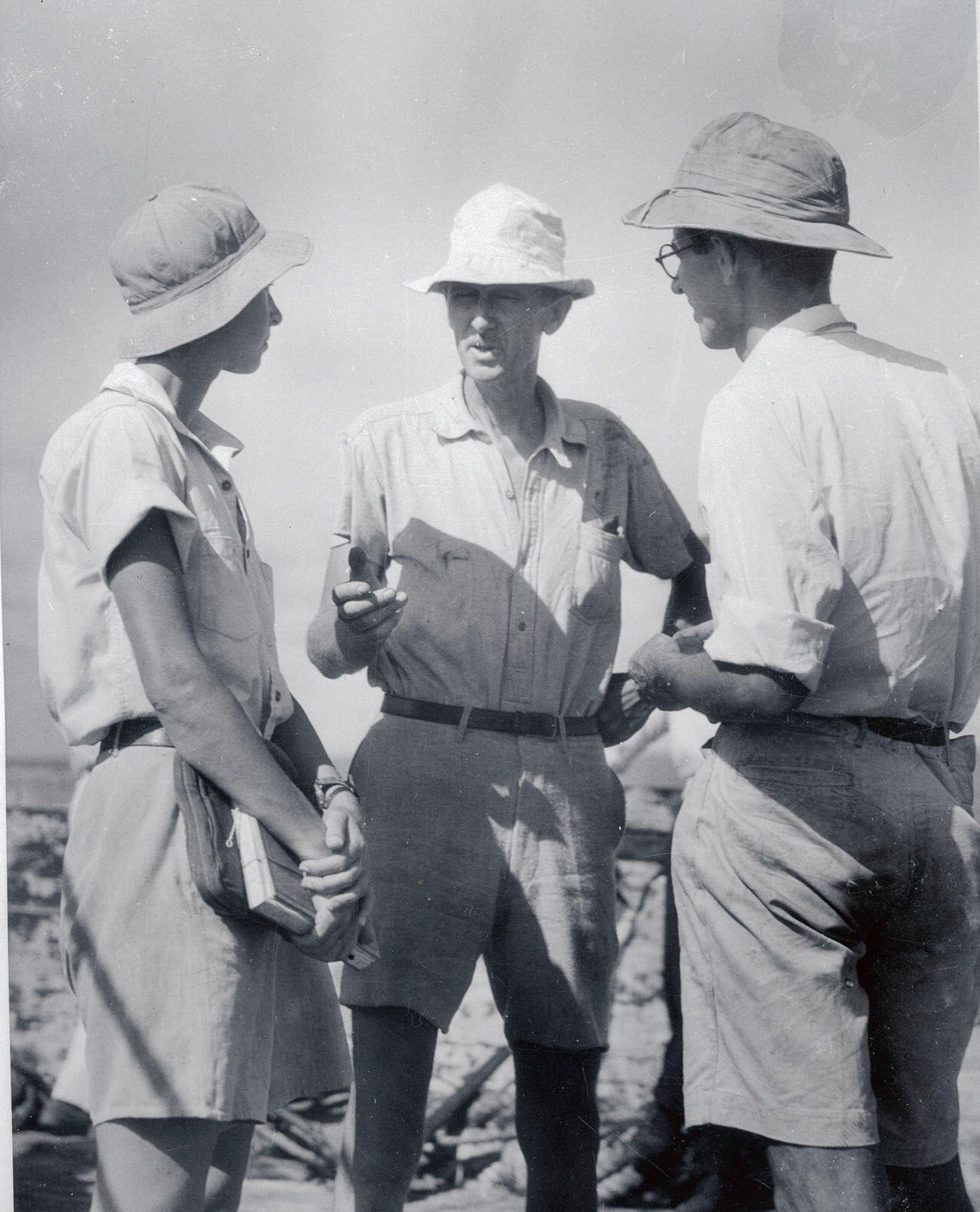
Under a bright, open sky, Dr. William Beebe stands at the center of a focused conversation, his hand raised as if sketching an idea in the air. On either side, aides Gloria Hollister and John Tee-Van lean in with the quiet attentiveness of field partners, dressed for heat and work in wide-brimmed hats and light shirts. Their relaxed stance suggests the kind of practical planning that happens between expeditions—part science, part logistics, and part shared curiosity about what lies beyond the shoreline.
Hollister’s notebook tucked at her side and Tee-Van’s intent posture hint at the steady documentation behind every celebrated discovery. The scene feels grounded in the era when ocean exploration depended not only on daring dives and ambitious equipment, but also on careful observation, note-taking, and constant problem-solving in the field. Even without a ship in the frame, the wind, glare, and coastal backdrop evoke a working day spent translating big questions about the sea into steps that a team can actually take.
Moments like this help explain why early marine science and deep-sea research were so often intertwined with invention—new tools, new methods, and new ways of thinking about life beneath the surface. Beebe’s exchange with Hollister and Tee-Van reads like a snapshot of collaboration in motion, where ideas are tested aloud before they are tested on the water. For readers drawn to the history of ocean exploration, marine biology, and the people who turned curiosity into fieldwork, this photograph offers a vivid, human-scale window into that process.