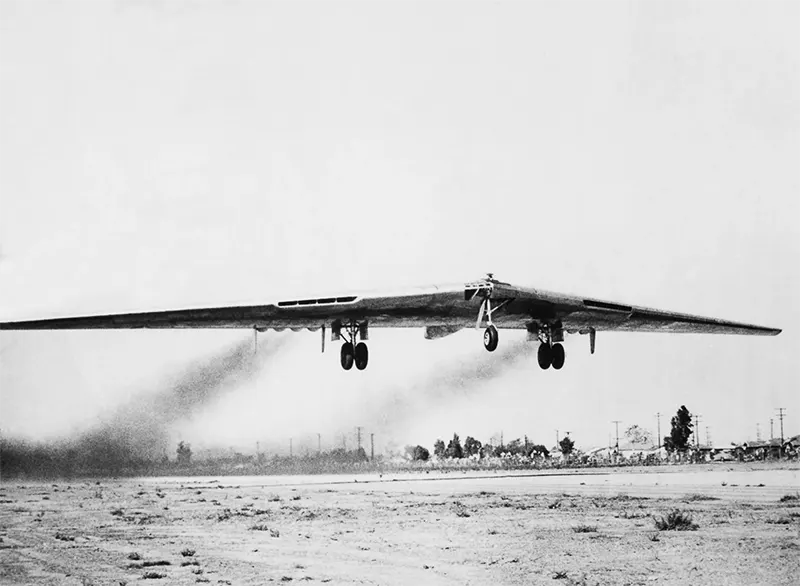
Low over the runway, a Northrop YB-49 lifts into the California air with its landing gear still hanging beneath a broad, seamless wing. The aircraft’s clean, tailless silhouette dominates the frame, while a plume of dust and exhaust trails behind, underscoring the power required to push an experimental flying wing into flight. Sparse scrubland and distant utility lines sit at the horizon, anchoring this moment of aerospace innovation in a working landscape rather than a polished showroom.
Few designs better symbolize the postwar race to rethink flight than the YB-49, a jet-powered successor to earlier flying-wing experiments. With no conventional fuselage-and-tail layout, the aircraft looks almost futuristic even in a period photograph, hinting at the aerodynamic ambitions and engineering risks that came with radical shapes. Test flights like the one suggested here were the proving ground where theory met reality—stability, control, and performance all judged in seconds after wheels left the ground.
For readers interested in aviation history, experimental aircraft, and the evolution of stealth-like forms, this image offers a vivid snapshot of mid-century American aeronautics. The scene blends invention with uncertainty: a bold design rising from a dusty field, watched over by a thin line of infrastructure and open space. It’s a reminder that breakthroughs often begin not with certainty, but with a daring takeoff and the willingness to test what hasn’t been proven yet.