Long before web browsers and shopping carts, retailers were already testing the idea of ordering from a screen and having goods delivered to your door. The title hints at a remarkably modern concept: a pre-internet “online” store where customers browsed electronically, made selections, and waited for a shipment rather than carrying purchases home. It’s a reminder that the convenience economy didn’t appear overnight—it was built through bold experiments in technology and logistics.
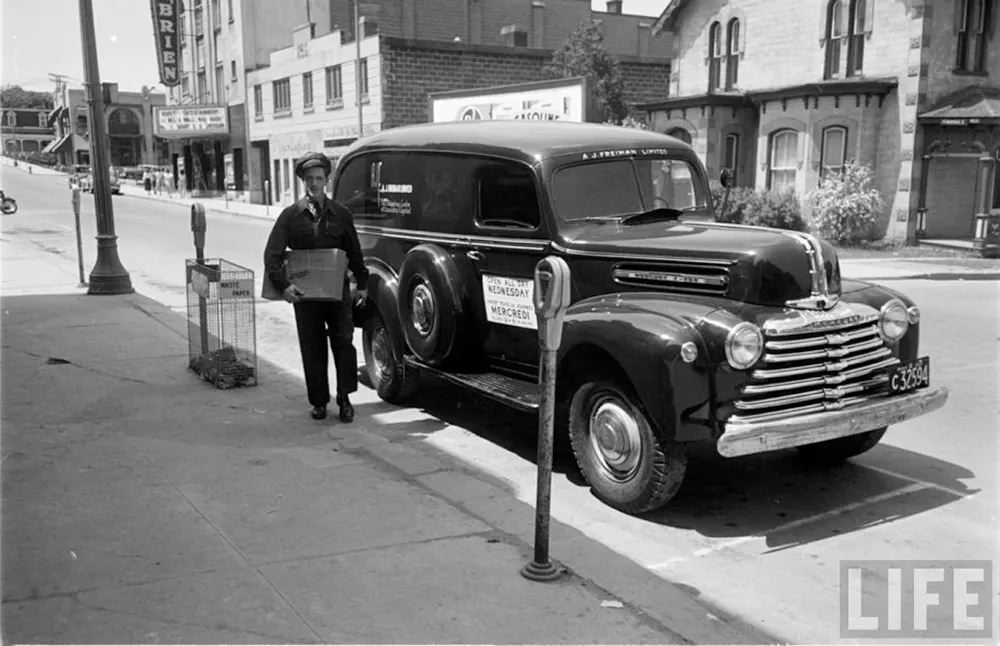
On the street in this photo, a delivery worker stands beside a sturdy mid-century panel truck, box in hand, as if punctuating the promise behind those early systems: the order may be virtual, but fulfillment is physical. The vehicle’s polished curves, the curbside parking, and the busy commercial blocks in the background evoke an era when distribution depended on drivers, routes, and warehouses more than on data centers. Even without seeing the storefront screens themselves, the scene underscores the essential backbone of remote shopping—last-mile delivery.
What makes this moment so fascinating for anyone interested in inventions and retail history is how familiar the workflow feels: browse, click (or the era’s equivalent), and receive. The technology may have been clunky, limited, and confined to a dedicated terminal, yet the ambition mirrors today’s e-commerce giants—reducing friction, expanding choice, and turning cities into networks of moving parcels. Look closely and you can almost hear the early pitch: shopping without shopping, powered by machines and completed by a truck at the curb.