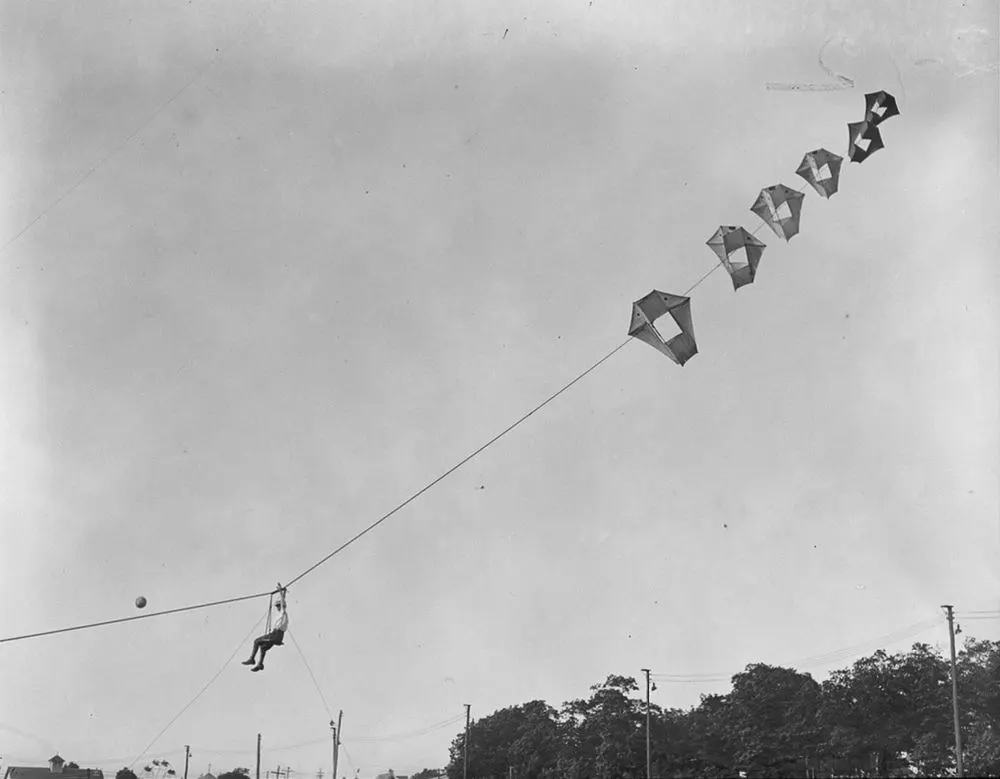
High above a quiet horizon, a train of boxy kites pulls taut on a single line, their angular frames stepping upward into open sky. Far below them, a lone figure hangs in a harness, suspended with legs dangling as if daring gravity to argue. The scene is sparse—trees, a few poles, and lots of empty air—which only heightens the sense that this is an experiment in making wind do the work of a machine.
Man-lifting kites were more than a fairground stunt; they sat at the crossroads of invention and early aerial reconnaissance, offering a way to raise an observer before practical aircraft became reliable. By linking multiple kites in a series, designers could spread the load and stabilize the pull, turning gusts into lift and lift into a temporary lookout. From aloft, the human payload could scan terrain, relay signals, or simply test the limits of what tethered flight could accomplish with canvas, spars, and courage.
What makes this historical photo so compelling is its glimpse of an overlooked technology: a wind-powered alternative to balloons and a precursor to later observation platforms. The composition emphasizes the engineering logic—line tension, kite spacing, and the careful balance between lift and drag—while also reminding us of the personal risk involved. If you’re fascinated by forgotten inventions, early aviation history, or the surprising origins of aerial surveillance, this image offers a vivid entry point into the incredible story of man-lifting kites.