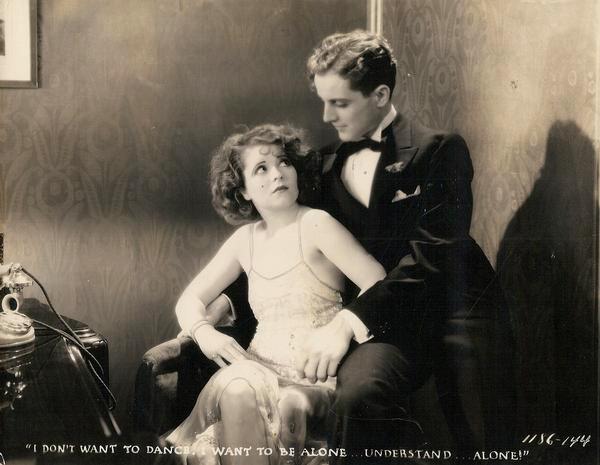
Clara Bow and Phillips Holmes share a tightly framed, intimate moment in this promotional still for *The Wild Party* (1929), a film often remembered for its charged blend of romance and backstage drama. Bow’s gaze tilts upward with a mix of defiance and vulnerability, while Holmes leans in with poised restraint, his tuxedo and slicked hair signaling the era’s screen sophistication. The soft studio lighting and patterned wall behind them keep the focus on expression and body language—silent-era storytelling at its most readable.
A small detail at the left edge—a period telephone on a side table—anchors the scene in modernity as it was imagined at the close of the 1920s, when films were beginning to sound like the world audiences lived in. The setting feels like a private corner carved out of a louder night, heightened by the way the couple’s hands meet and hold, suggesting both comfort and pressure. Along the bottom margin, a printed line of dialogue (“I DON’T WANT TO DANCE… I WANT TO BE ALONE… UNDERSTAND… ALONE!”) adds a dramatic hook and hints at the character tension that made early talkies so captivating.
For collectors and classic Hollywood fans, this image works as a vivid snapshot of late-1920s cinema style—sleek wardrobe, carefully staged emotion, and marketing designed to sell atmosphere as much as plot. It’s an excellent fit for posts about Clara Bow, Phillips Holmes, *The Wild Party*, and the transition era of Movies & TV when glamour met new cinematic realism. Whether you’re researching film history or simply curating vintage movie photography, the still invites a closer look at how studios shaped star power and intimacy for the camera.