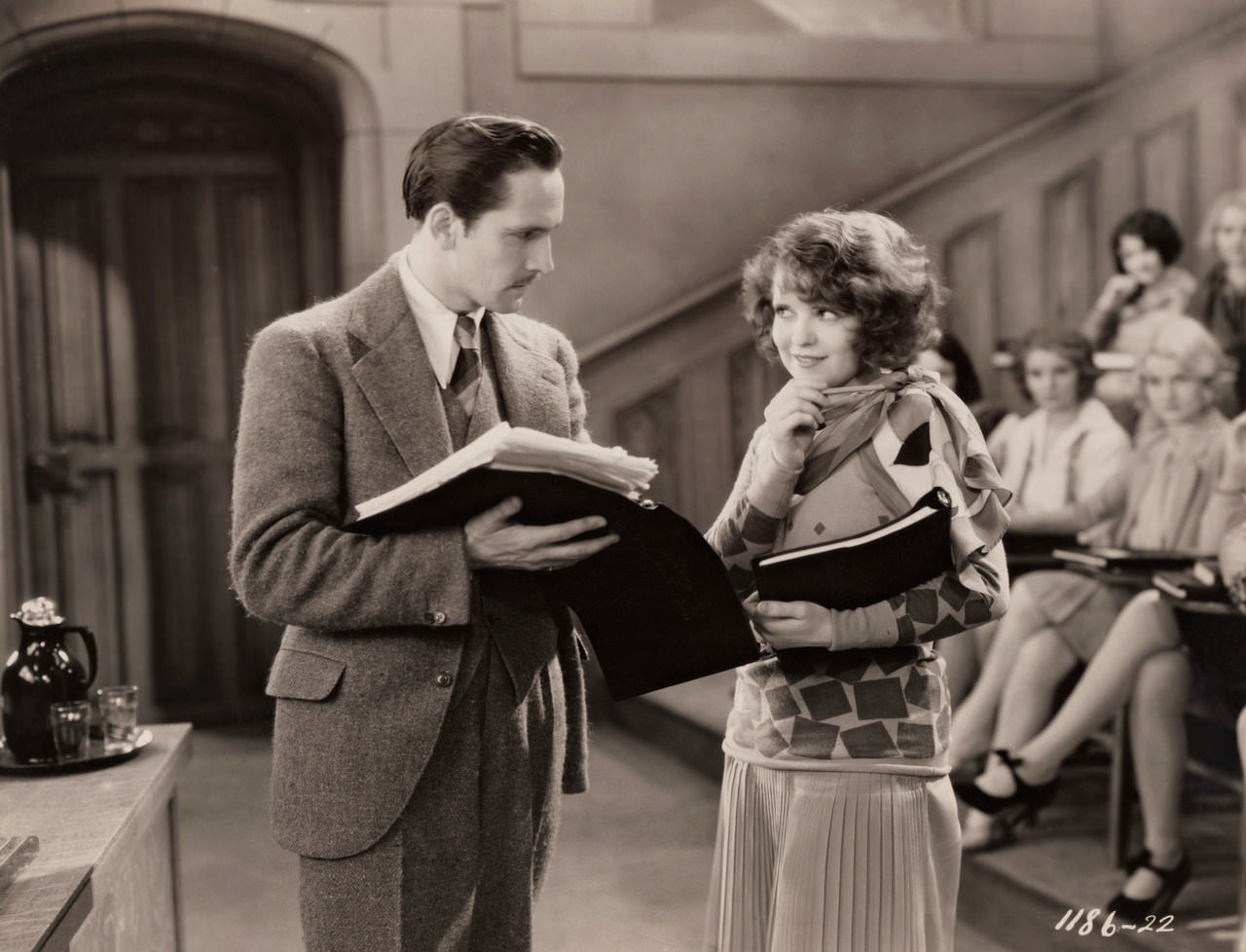
A tense little triangle of attention unfolds in this still from *The Wild Party* (1929), with Fredric March studying an open folder while Clara Bow turns toward him, half-smile in place, as if she already knows how the exchange will land. Their wardrobe—his structured suit and her patterned sweater with a soft scarf—plants the moment firmly in late-1920s screen style, where modern silhouettes and expressive faces carried as much story as the dialogue. The setting feels like an interior room set for scrutiny, and the actors’ body language supplies the friction.
Behind them, a row of seated women watches from the background, creating the sense of an audience within the scene and heightening the stakes of whatever is being read or decided. A staircase and paneled walls frame the group, while a small service table at the left edge hints at a social gathering that has paused for something more serious. Even without motion, the composition directs the eye from the papers to Bow’s knowing glance, then outward to the observers, suggesting reputation, judgment, and performance all at once.
For classic film fans and silent-era historians, *The Wild Party* stands at a fascinating crossroads in Hollywood’s shift toward talkies, and this promotional-style photo preserves that transitional atmosphere in crisp detail. It’s an evocative snapshot of Clara Bow’s star charisma paired with Fredric March’s focused presence, capturing the kind of intimate confrontation that defined many late-1920s dramas. As a WordPress feature image, it’s a strong, SEO-friendly piece for posts about vintage cinema, early sound films, and the enduring pull of Golden Age movie publicity photography.