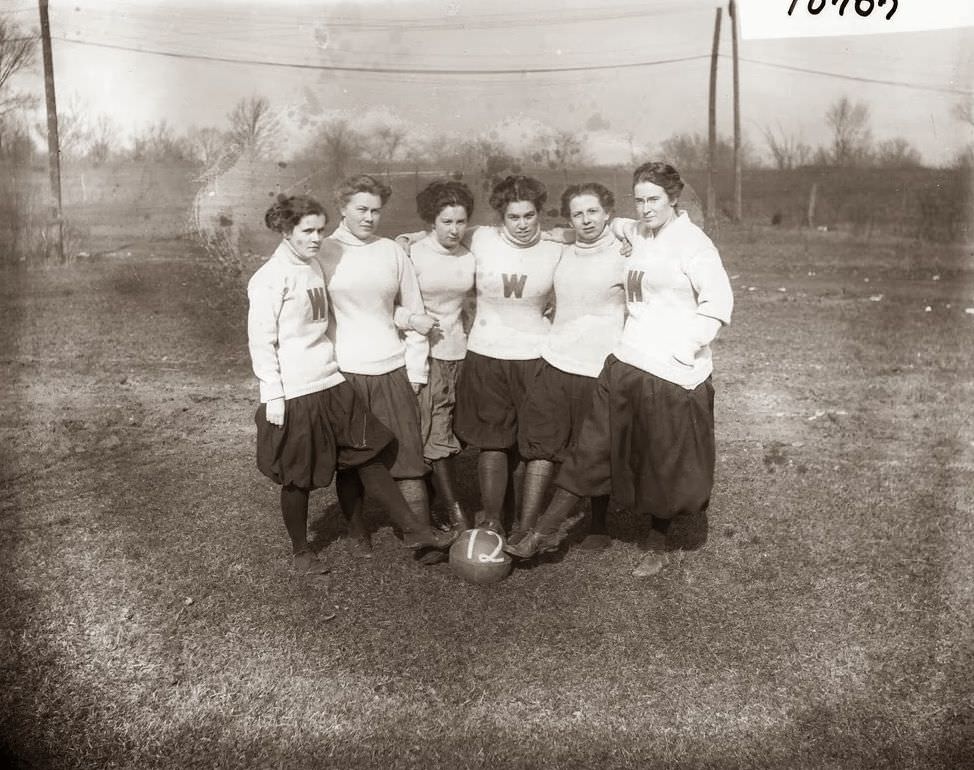
Linked arm in arm, six Western College players pose with the easy camaraderie of a team that has spent long practices together. Their sweaters bear a bold “W,” and a well-used ball marked “12” rests at their feet, anchoring the scene in the early era of collegiate basketball. Though the title places the group around 1910, the photograph’s spirit is timeless: pride, unity, and the quiet confidence of athletes ready for competition.
Uniform details tell their own story about sports culture at the turn of the twentieth century—high-neck tops, full skirts, and sturdy boots suited as much to modesty as to movement. Rather than a polished gym portrait, the team stands outdoors on a rough field, with bare trees and utility poles in the distance, suggesting how flexible and improvised athletic spaces could be in college life of the period. Faint creases and surface wear on the print add another layer of history, reminding us this is an artifact that has traveled through many hands.
For anyone researching Western College athletics, women’s basketball history, or early 1900s student life, this image offers a vivid snapshot of a formative moment in American sports. It invites questions about training routines, rules of play, and the social world that surrounded women’s teams when basketball was still establishing itself on campuses. As a piece of sports heritage, it preserves not only a lineup, but a chapter of ambition and belonging stitched into those “W” sweaters.