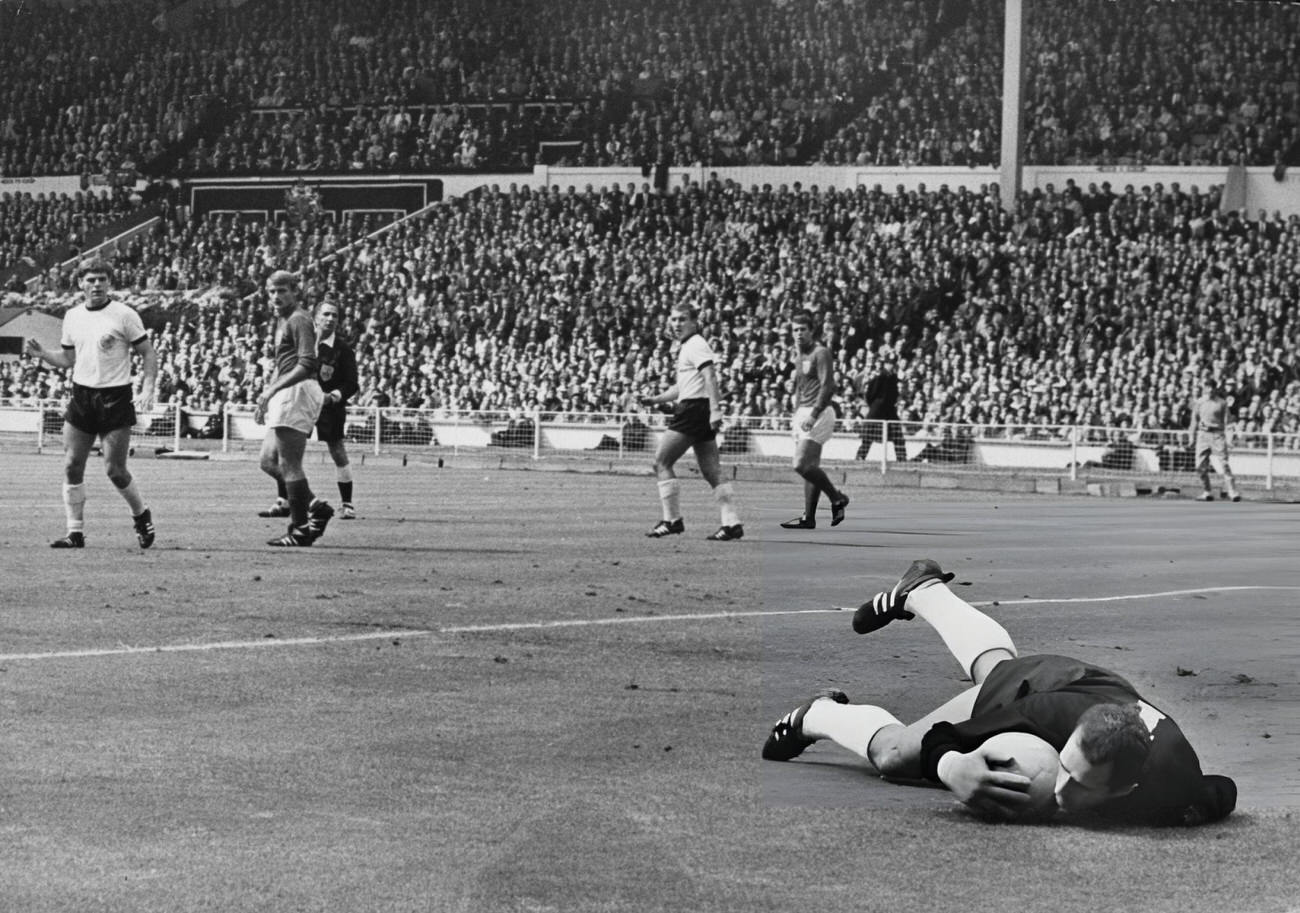
Across the grass in the foreground, West Germany’s goalkeeper Hans Tilkowski lies stretched out with the ball gathered safely to his chest, the kind of full-body commitment that turns a fierce shot into a fleeting memory. The packed terraces behind him form a dense wall of faces, reminding us how enormous the stakes felt in 1966 when every save carried the weight of a nation’s hopes. Even in stillness, the moment reads like a heartbeat: action just completed, the danger snuffed out, and the crowd held in suspense.
Further upfield, players in contrasting kits slow their steps and glance back toward the goalmouth, registering what has just happened. England’s Bobby Charlton, renowned for driving efforts from range, is named in the title as the shooter—an encounter that instantly situates this photograph in the drama of top-level international football. The wide stadium view, the simple barriers, and the unadorned pitch surface evoke a World Cup era when the game looked rawer, heavier, and gloriously direct.
What makes this historical sports photo resonate is its emphasis on goalkeeping as craft and courage rather than glamour: the low dive, the secure hold, the quick decision to smother rather than parry. For readers searching for 1966 football history, World Cup archives, or classic England vs West Germany moments, Tilkowski’s save offers a sharp, human-scale window into the contest. It’s a reminder that legendary matches are built from split seconds like this—when a single stop redraws the next passage of play.