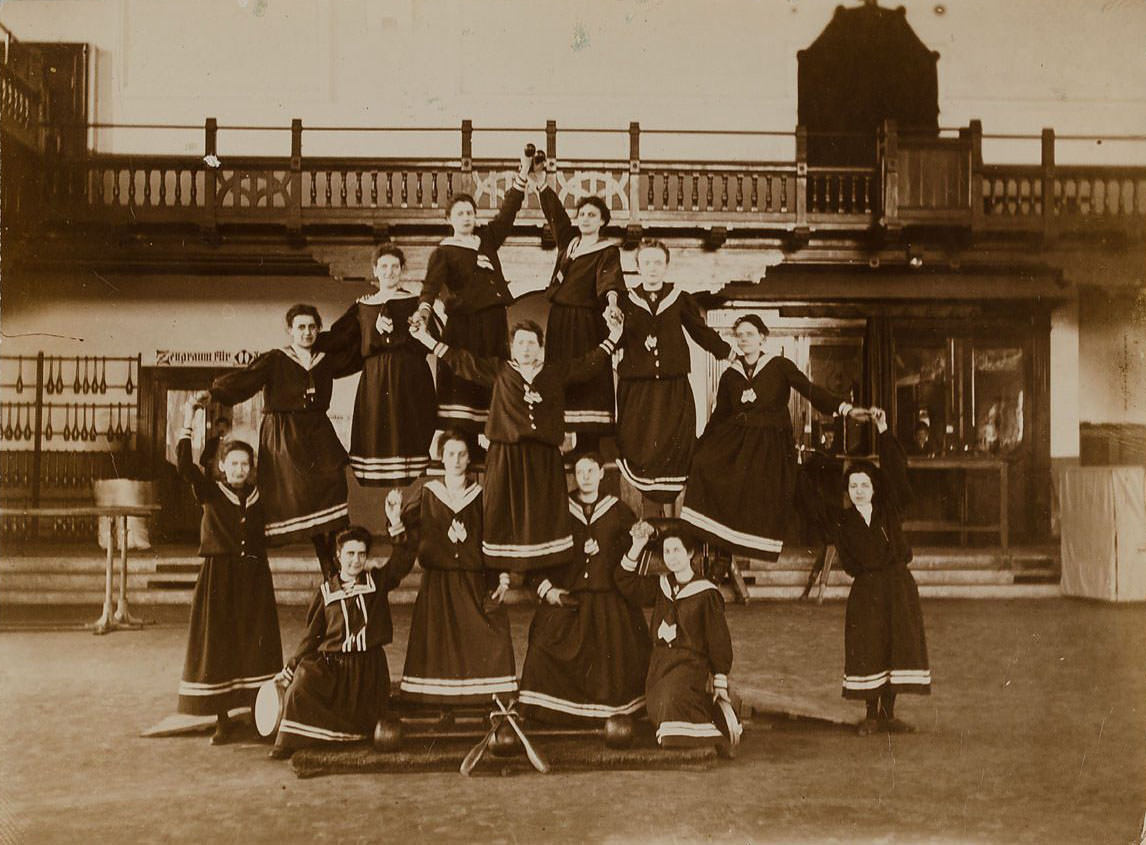
Poised in a carefully balanced human pyramid, a group of German women holds their formation with arms outstretched and hands linked, turning exercise into a public spectacle. Their matching dark dresses with crisp sailor-style collars create a striking uniformity, while the open training space and rails behind them suggest an organized gymnastic hall rather than a casual gathering. The stillness of the pose, captured mid-routine, hints at the discipline and rehearsal required for Swedish gymnastics in the early 1900s.
Swedish gymnastics—known for structured movements, posture, and coordinated group work—spread widely across Europe as a modern approach to physical culture. In Heinrich, Germany, scenes like this reflect how women’s sport and fitness were increasingly tied to education, health, and community clubs, even when athletic clothing still resembled everyday dress. The props on the floor and the staged arrangement speak to a program that valued precision, teamwork, and presentation as much as strength.
For readers interested in historical sports photography, this image offers a vivid window into women’s gymnastics culture in Germany during the 1900s. Look closely at the confident stances, the symmetrical composition, and the blend of formality and athletic ambition—details that make the photograph both a document of training and a portrait of social change. It’s an evocative reminder that organized women’s sport has deep roots, built on collective effort and carefully practiced movement.