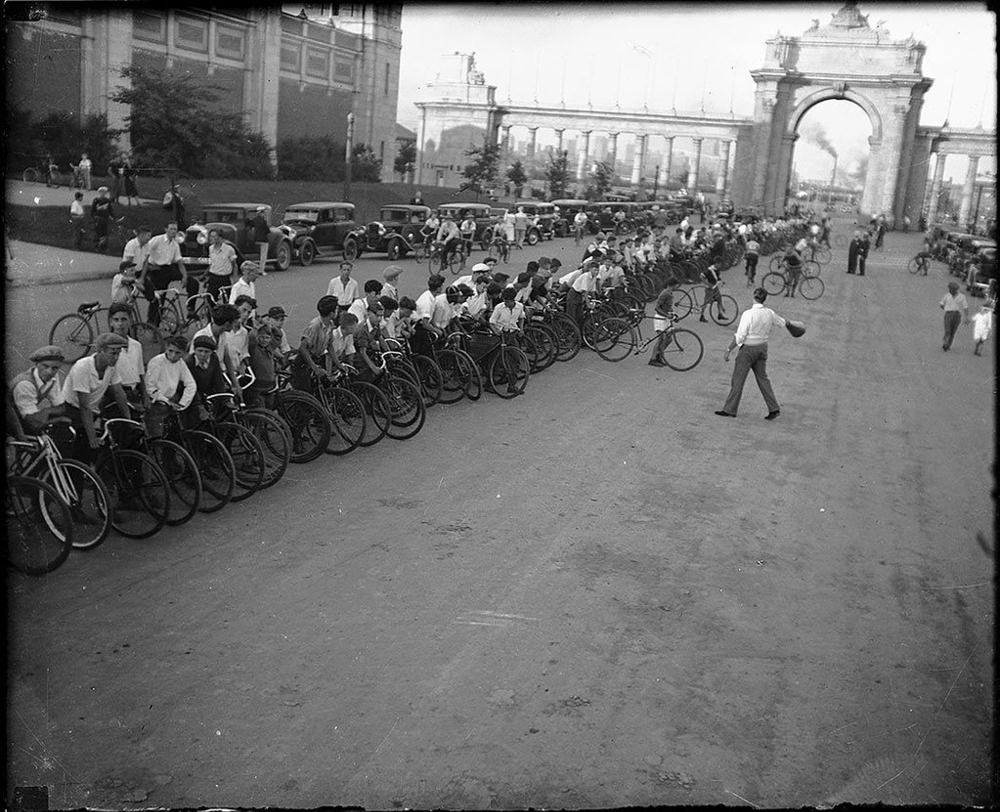
A long line of cyclists stretches across a broad Toronto roadway, front wheels angled toward the open space ahead as they wait for the signal to start. Caps pulled low and shirtsleeves rolled, the riders sit tightly packed in a formation that suggests both competition and camaraderie. The scene feels like a community event as much as a sporting contest—an organized moment when everyday bicycles became race machines.
Behind the riders, early automobiles are parked bumper-to-bumper, their boxy silhouettes hinting at a city in transition where cars and bikes shared the same streets. The monumental arch in the distance frames the course like a ceremonial gateway, turning an ordinary road into a stage for public spectacle. Spectators and officials dot the edges, and one figure steps forward with an arm raised, poised to release the crowd into motion.
For readers interested in cycling in Toronto from the early 1900s, this historical photo offers a vivid snapshot of street racing culture and the urban backdrop that shaped it. It speaks to an era when organized sports drew attention to public spaces and when bicycle racing helped define local leisure, fitness, and friendly rivalry. Whether you come for the period details or the sheer scale of the lineup, the image captures the anticipation that always precedes the first hard pedal stroke.