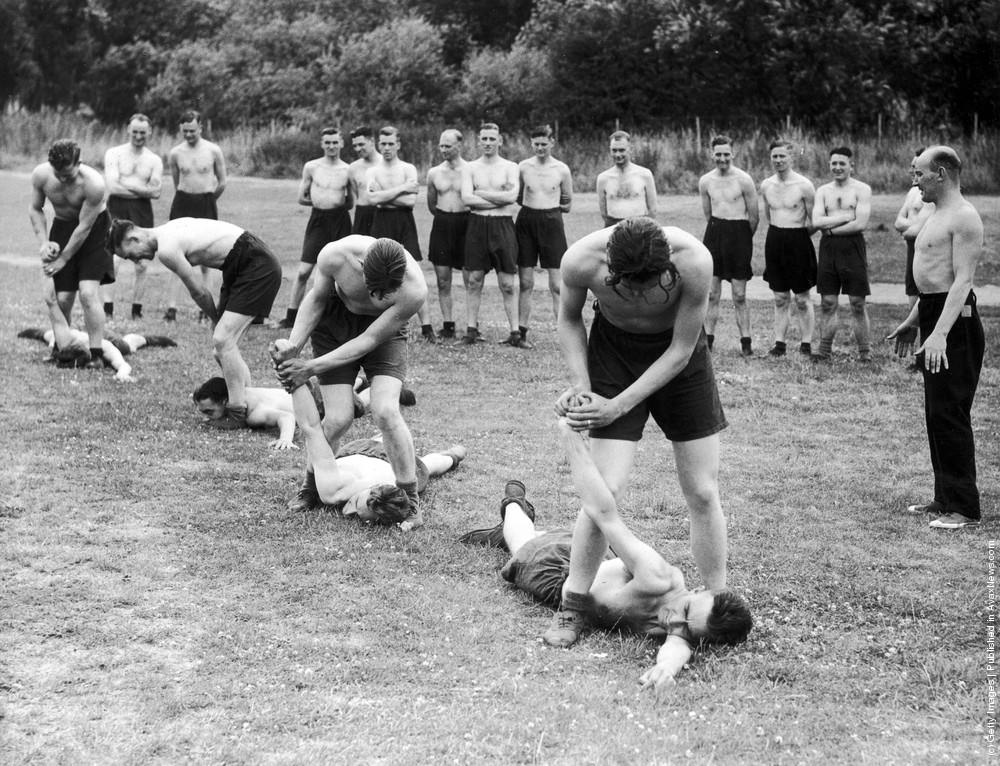
Across a grassy training ground, RAF Police recruits practise ju-jitsu in paired drills while a line of shirtless men stands behind them, arms folded, watching closely. In the foreground one trainee applies a firm leg hold as his partner lies flat, the posture suggesting a controlled technique rather than a brawl. The open-air setting and improvised feel of the session underline how physical instruction could be woven into everyday military routine in 1940.
Ju-jitsu, long associated with self-defence and restraint, suited a policing role where control mattered as much as strength. The photograph’s emphasis on grips, leverage, and ground work hints at practical preparation for guarding installations, handling prisoners, and responding to incidents without relying solely on weapons. Even in a sports-like context, the disciplined spacing of the onlookers and the calm supervision at the edge of the frame convey a structured course designed to build confidence under pressure.
What lingers is the contrast between camaraderie and intensity: men waiting their turn, learning by watching, then stepping in to repeat the movements on the grass. For readers interested in RAF Police history, wartime training, and martial arts in the military, this image offers a vivid glimpse of how recruits were shaped into fit, adaptable personnel. It’s a small but telling window into the physical culture of the Royal Air Force at the start of a demanding decade.