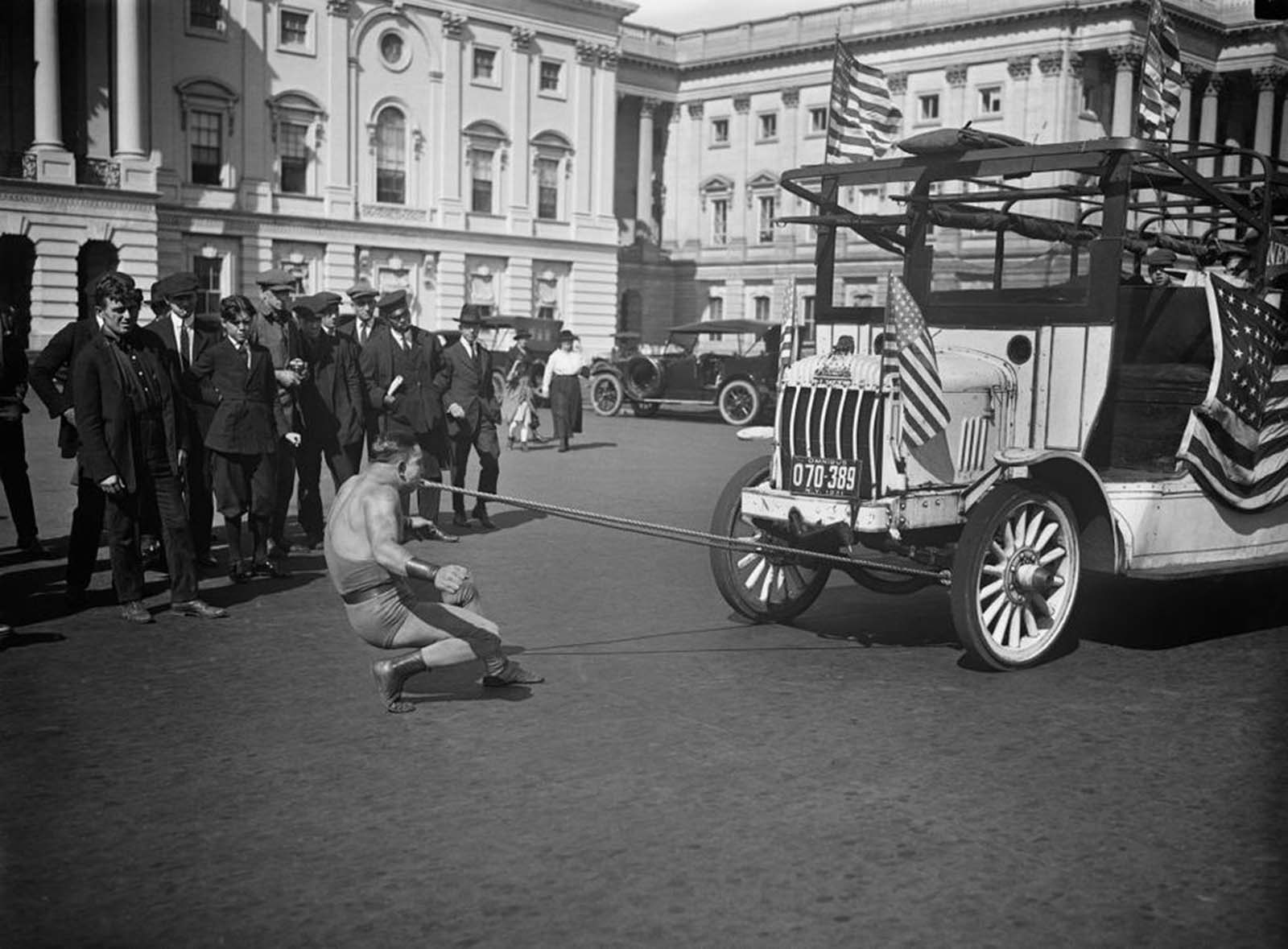
On a broad stretch of pavement outside the U.S. Capitol in Washington, D.C., a strongman drops low, braces his legs, and bites down on a rope that runs straight to the front of an early automobile. The car itself is dressed for spectacle—American flags flutter from the body—while a line of onlookers in caps and suits gathers close, watching for the moment the wheels begin to turn. It’s a vivid snapshot of 1921 showmanship, where daring stunts turned public spaces into impromptu stages.
What makes the scene so striking is the contrast between human grit and modern machinery: a single performer trying to budge a heavy vehicle using nothing but leverage and jaw strength. The crowd’s posture—hands in pockets, heads tilted forward—suggests both curiosity and disbelief, the same mix that fueled vaudeville, traveling exhibitions, and early sports entertainment. Even the Capitol’s grand architecture looms in the background, lending an official backdrop to an act that is anything but ordinary.
Viewed today, this historical photo reads as more than a curiosity; it’s a glimpse into early 20th-century strength culture and the era’s appetite for extreme feats. The image also captures a transitional America, where automobiles were becoming commonplace and public attention could be won through physical spectacle and a well-timed demonstration. For readers interested in vintage sports history, strongmen traditions, or Washington, D.C. in the 1920s, it’s a memorable moment frozen in motion and muscle.