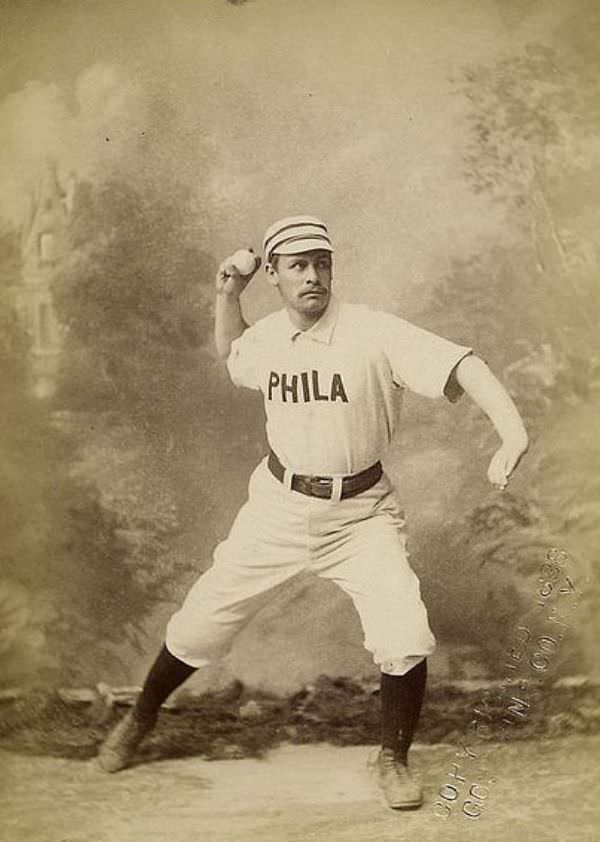
Poised mid-throw against a painted studio backdrop, a uniformed ballplayer turns early baseball into something almost theatrical. The bold “PHILA” lettering across his chest, the striped cap, and the deliberate stance suggest a time when photographers asked athletes to hold motion still long enough for the camera to catch it. Instead of dust, noise, and baselines, we get a carefully arranged moment that hints at the sport’s growing public image.
Long before candid action shots and press-box lenses, studio portraits helped build the look of 19th-century baseball—part athletic contest, part formal presentation. Details like the high socks, sturdy belt, and tucked trousers show how equipment and style differed from the modern game, while the player’s focused gaze sells the idea of professionalism. Even the soft vignette and staged “outdoor” scenery remind us that many fans first met their heroes on paper, not in person.
For collectors and historians, images like this are valuable not only as sports memorabilia but as cultural snapshots of how America’s pastime was marketed and remembered. The combination of team identification and posed motion makes it a strong example of early baseball photography, ideal for anyone researching vintage uniforms, studio techniques, or the evolution of player portraiture. If you’re drawn to the roots of the game, this portrait offers a quiet, compelling bridge between the ballpark and the photographer’s studio.