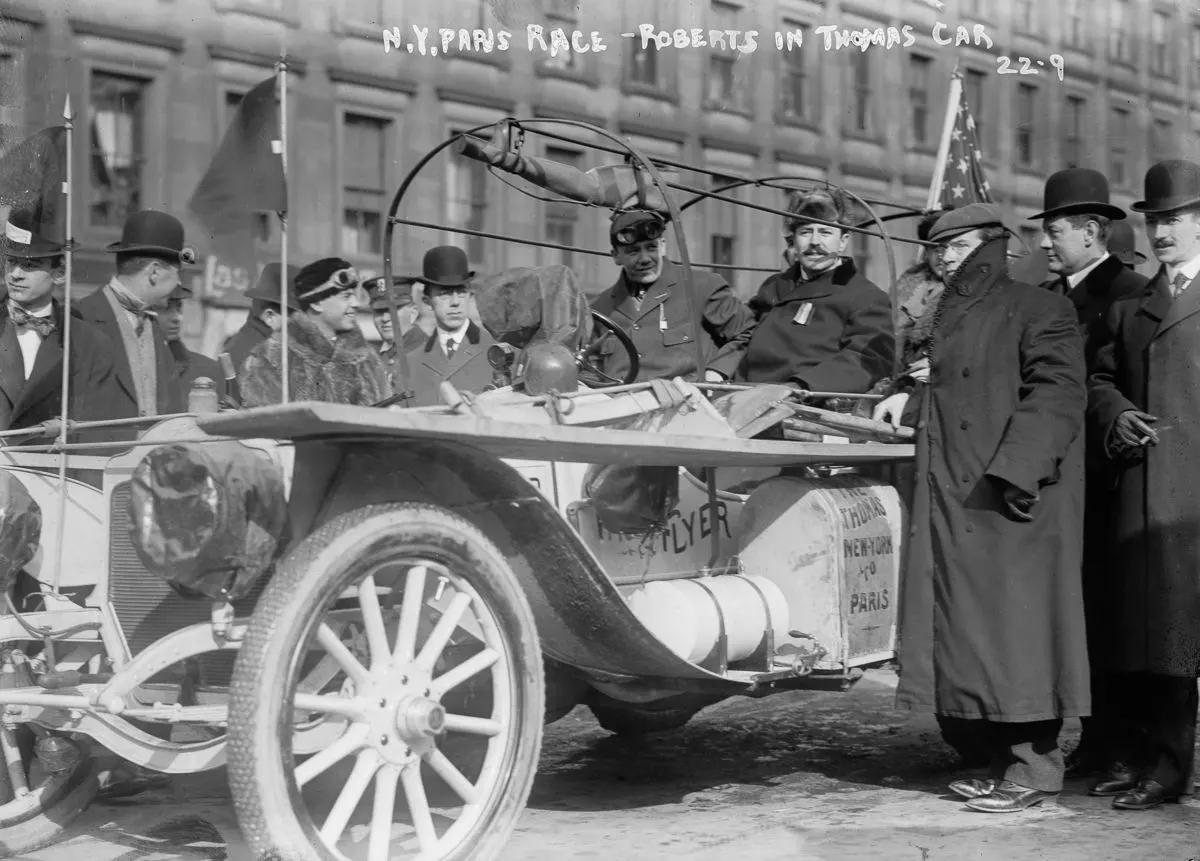
Crowds press in close as the American Thomas Flyer sits at the center of attention, its tall spoked wheels and open cockpit hinting at a long, punishing road ahead. Handwritten lettering above the scene ties the moment to the New York to Paris race, while flags and bundled spectators turn the street into a makeshift starting stage. The car’s exposed framework, strapped-on gear, and weather-ready coverings underline how early motorsport was as much about improvisation as speed.
George Schuster and Montague “Monty” Roberts are presented not as distant celebrities but as working drivers, dressed for cold air and hard miles, surrounded by officials and onlookers in heavy coats and bowler hats. The Flyer’s cabin looks cramped, with controls and equipment packed into every usable space—an honest portrait of endurance racing before streamlined bodies and enclosed comfort. Even at a standstill, the machine feels purposeful, built to be repaired quickly and driven relentlessly.
For readers exploring the Great New York to Paris Auto Race of 1908, this photograph offers a vivid window into the ambition of early American automotive engineering and the public fascination it inspired. The Thomas Flyer wasn’t just a race entry; it was a rolling argument that a motorcar could cross continents when roads were uncertain and logistics were experimental. As a piece of racing history and vintage automotive imagery, it brings the era’s grit and spectacle into sharp focus for collectors, historians, and SEO seekers of “Thomas Flyer,” “New York to Paris race,” and early endurance motorsport.