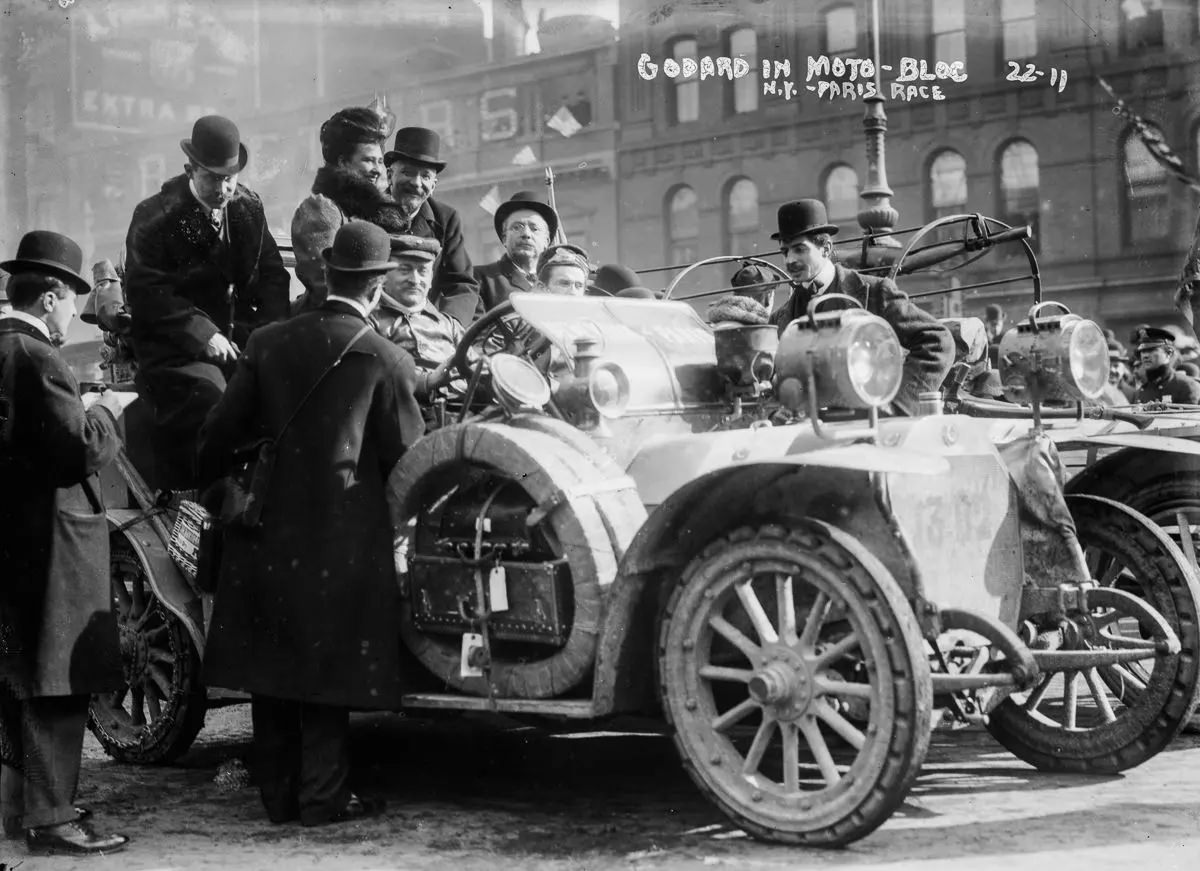
Crowds press in close around the French Moto-Bloc as Charles Godard sits at the wheel, turning a racing start into a public spectacle. The handwritten caption on the image ties the moment to the New York–Paris race, and the scene feels half sporting event, half street theater: bowler hats and heavy coats, curious faces leaning over the bodywork, and an atmosphere of loud anticipation.
Mechanical details steal their share of attention—the exposed lamp assemblies, spoked wheels, and the sheer bulk of the machine built for endurance rather than comfort. Everything about the car suggests early motoring’s practical improvisation, when reliability depended as much on the crew and on-the-spot fixes as it did on engineering. Even at rest, the Moto-Bloc looks like it’s been fashioned to endure long miles, rough surfaces, and whatever conditions the route might throw at it.
Set against the wider story of the Great New York to Paris Auto Race, this photo captures the human scale of an international challenge: driver, machine, and onlookers sharing the same cramped space before the road opens up. For readers exploring vintage motorsport history, early 20th-century automobiles, and the legendary New York–Paris competition, Godard’s Moto-Bloc offers a vivid window into an era when crossing continents by car was still an audacious experiment.