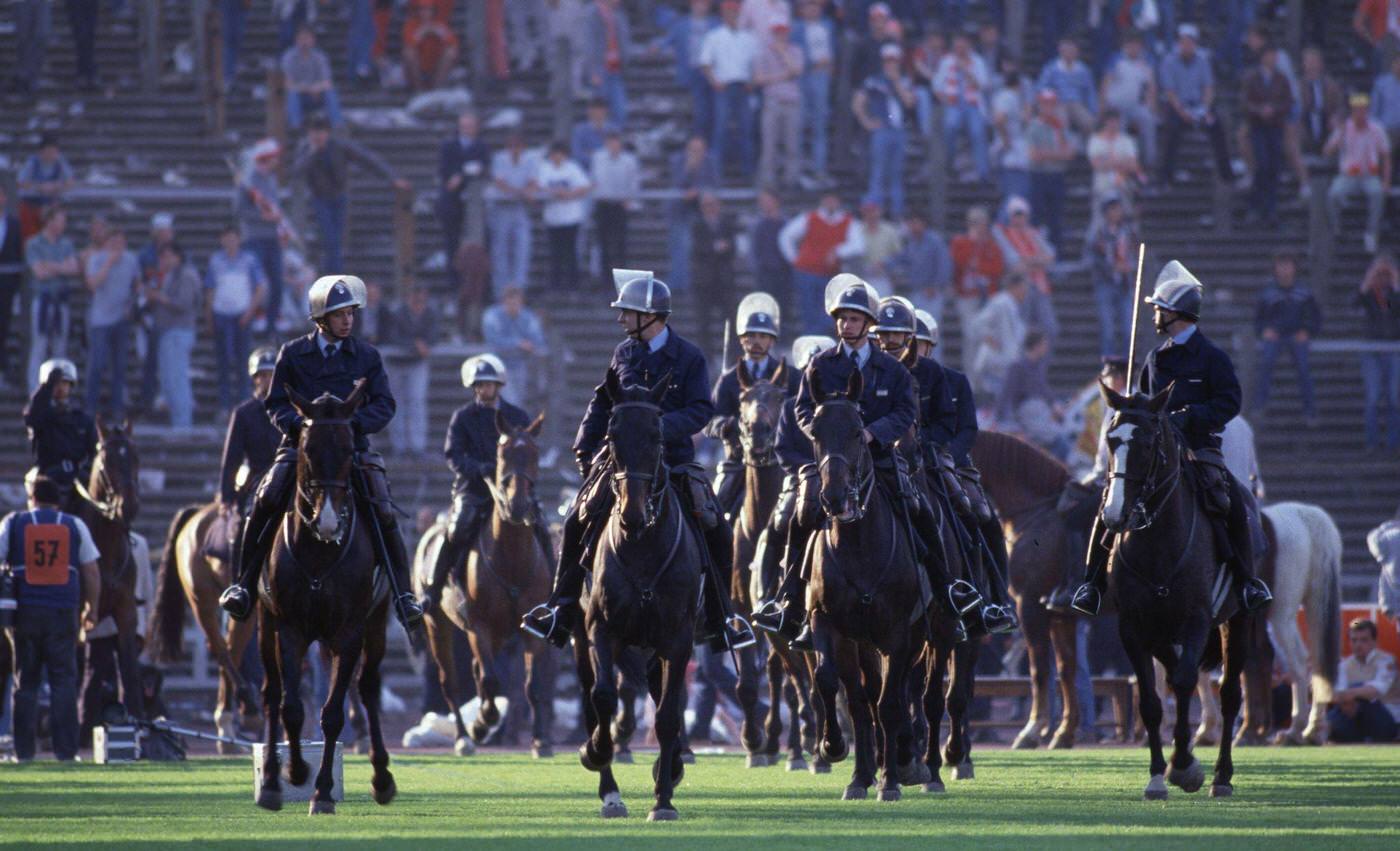
Mounted police move in a tight line across the grass, helmets low and batons visible, turning a football pitch into a corridor of control. Behind them, the terraces are crowded with onlookers—some standing, some pressed into rows—while the late-day light catches the sheen of uniforms and the nervous energy in the scene. The framing emphasizes distance and authority: riders in the foreground, spectators in the background, separated by more than just space.
Set against the match billed as Juventus vs. Liverpool in 1985, the moment evokes the broader story of the Heysel Stadium disaster and the grim shift it forced upon European football. What should have been a showcase of sport becomes, in a single still, a record of disorder and emergency response, when policing and crowd management abruptly took center stage. It’s a stark reminder that football history is written not only in goals and trophies, but also in the decisions made when safety collapses.
For readers searching the Juventus Liverpool 1985 photo, Heysel Stadium tragedy images, or riot police on a football field, this picture offers a direct, unsettling window into that night’s atmosphere. The horses’ measured stride and the officers’ formation convey urgency without chaos, as if the authorities are trying to impose calm after it has already been lost. In the aftermath, this kind of scene helped reshape stadium security, fan segregation, and the way major matches were planned and policed for decades to come.