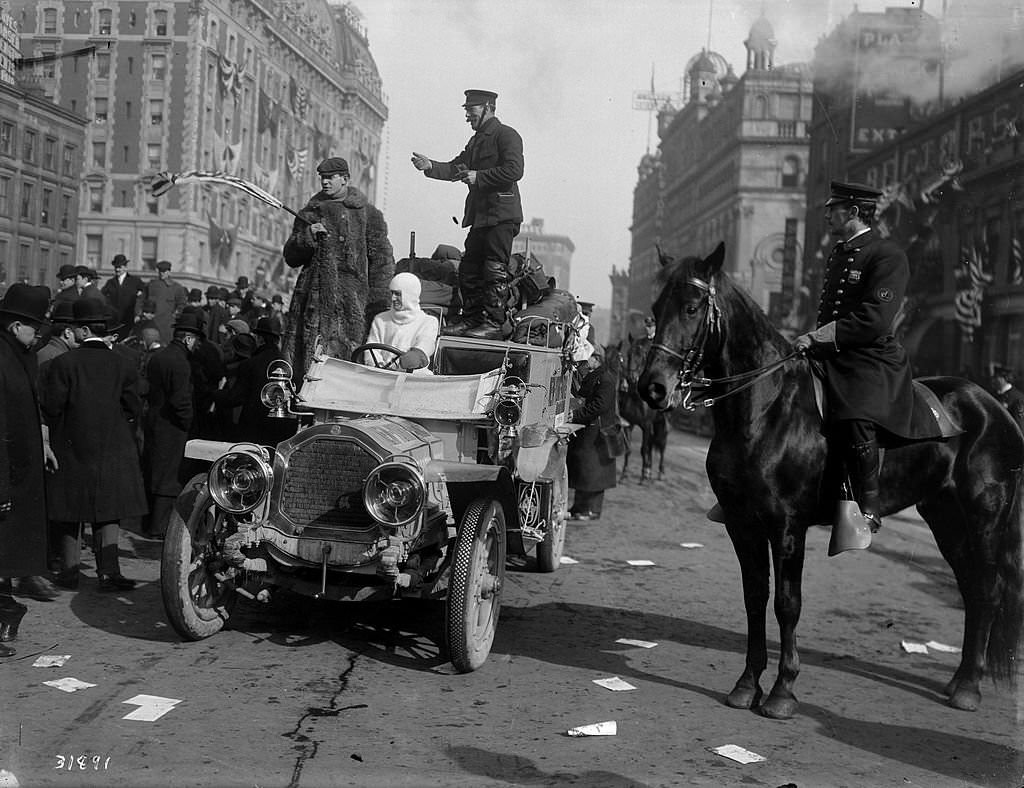
Crowds press in along a broad city street as the Thomas Flyer idles at the starting line of the famed New York to Paris auto race, its tall radiator, lantern-like headlamps, and spoked wheels framed by bundled spectators and flag-draped buildings. A uniformed officer sits astride a horse nearby, underscoring how new and unruly this kind of motoring spectacle still felt in an age when horsepower was often literal. Perched above the car, crew and officials add to the sense of organized chaos—part parade, part experiment, part dare.
Details in the machine hint at the realities ahead: gear lashed to the body, tools and supplies piled high, and a driver wrapped for cold, wind, and road grit. Unlike modern endurance events run on closed courses, an “around the world” contest demanded improvisation, repairs on the fly, and navigation through rough terrain where maps and roads could vanish without warning. The Thomas Flyer’s sturdy build and practical preparation seem less like luxury motoring and more like expedition travel.
Knowing from the title that the Thomas Flyer eventually won gives the scene a charged, anticipatory weight, as if this moment freezes the last breath before weeks of hardship and mechanical trial. The photo captures the New York to Paris race at the crossroads of old and new—police on horseback beside a cutting-edge automobile, a cheering crowd watching a technology test itself against distance. For readers drawn to early car history, endurance racing, and the legend of the Thomas Flyer, it’s a vivid starting point to one of motoring’s most ambitious adventures.