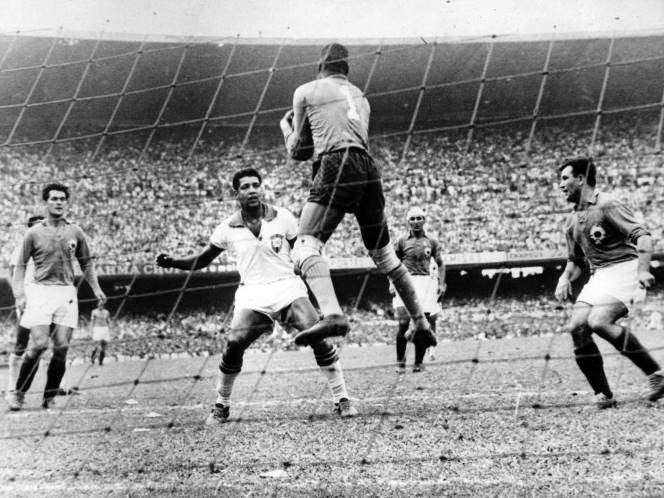
Tension hangs in the air as the goalkeeper launches himself into a crowded goalmouth, arms raised and eyes fixed on the ball while attackers and defenders converge beneath him. The netting in the foreground frames the action like a cage, pulling you into the split-second drama that defined football’s biggest stages. In the background, the terraces swell with spectators, a living backdrop that makes the pitch feel smaller and the stakes even larger.
The post title points to a pivotal Maracanã group match, where the hosts, coming off a 2–2 draw earlier in the campaign, sealed top spot in Group 1 by beating Yugoslavia 2–0 before an astonishing crowd of 142,000. That context sharpens every detail in the photograph: the urgency in the players’ body language, the way defenders hold their line, and the instinctive leap of the keeper as the moment turns into a test of nerve. It’s a reminder that tournament progress is often decided not by long passages of play, but by a handful of contested balls in front of goal.
For readers searching for World Cup history, Maracanã stadium memories, or classic football photography, this scene offers a vivid window into the era’s tempo and physicality. The heavy turf, simple kits, and tightly packed stands evoke a time when the spectacle was built as much by the crowd as by the game itself. More than a match report frozen in silver and grain, it’s an atmosphere you can almost hear—an immense stadium holding its breath as a single save, touch, or rebound threatens to rewrite the story.