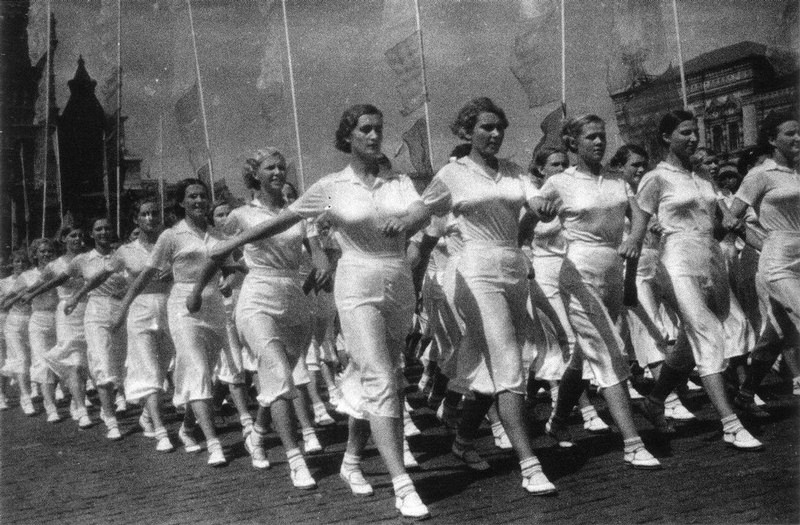
Rows of young women stride forward in tight formation, arms swinging in unison and faces set with concentration, turning physical culture into a public performance. Matching white athletic outfits and practical shoes emphasize uniformity and discipline, while tall flags and a city backdrop suggest a parade-like event staged for an audience beyond the participants themselves. The scene fits the era’s fascination with organized movement, where sport and spectacle met on broad streets under open skies.
What stands out is the choreography of strength: the long line receding into the distance, the repeated rhythm of steps, and the sense of collective purpose that overpowers individual flair. These Soviet sport girls appear less like casual exercisers and more like trained participants in mass gymnastics, embodying ideals of health, readiness, and modern womanhood promoted in the 1930s. Even without a specific caption, the visual language is clear—fitness here is civic, communal, and proudly displayed.
For readers searching for vintage Soviet sports photography, this image offers a vivid glimpse into how female athleticism was framed and celebrated in public life. It’s a reminder that the decade’s sporting culture was not only about competition, but also about building morale, shaping bodies, and signaling “strong will” through synchronized motion. As part of a broader collection, the photograph invites closer attention to posture, costume, and setting—the small details that reveal how everyday athletes were woven into a larger historical narrative.