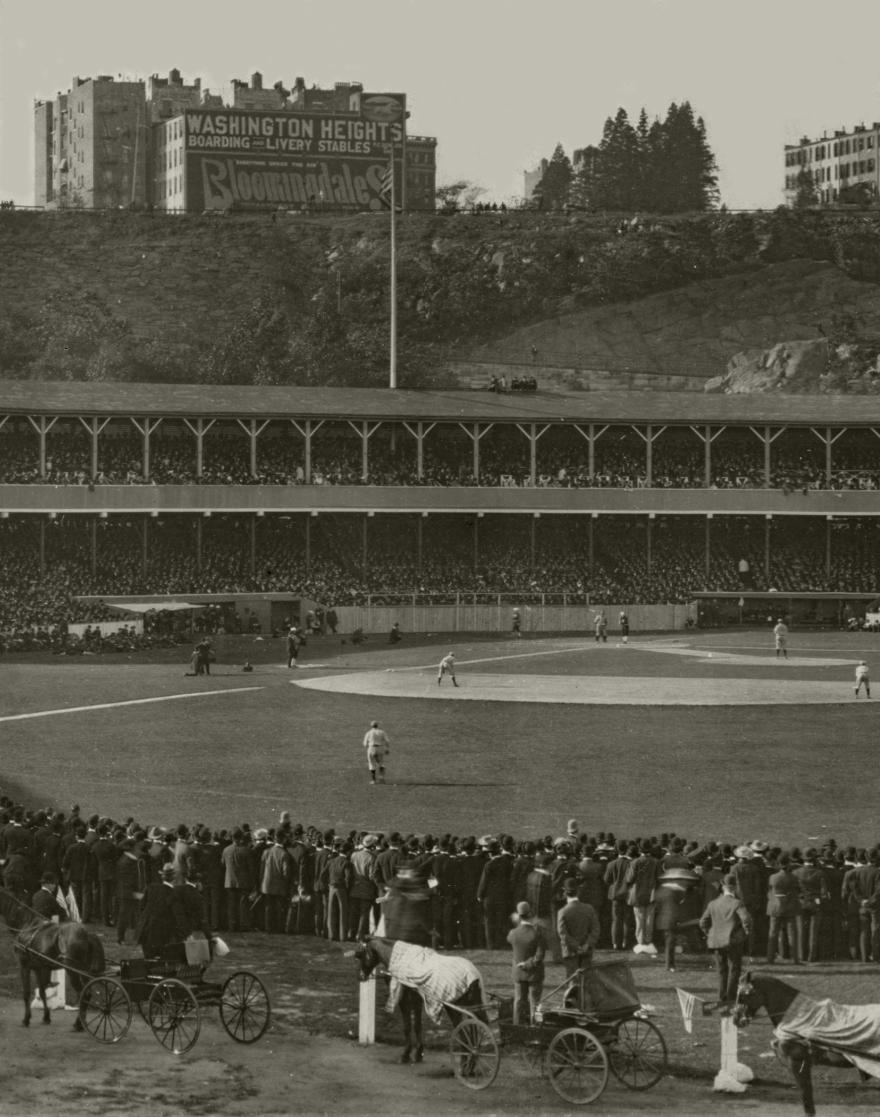
Crowds press right up to the edge of the grass at the 1905 World Series, turning the outfield into a boundary drawn by people rather than lumber. With no solid outfield wall in sight, spectators stand shoulder to shoulder along the open perimeter, hats and coats forming a dark ring around the field. The grandstand rises behind them, packed to the rafters, while players look almost small against the sweeping bowl of early ballpark architecture.
Beyond the stands, the city announces itself through painted rooftop advertising, including a prominent “Washington Heights” sign and a bold “Bloomingdale’s” message looming over the hillside. That backdrop hints at how tightly baseball and urban life were intertwined—commerce, neighborhood identity, and the day’s biggest sporting drama sharing the same skyline. Even the rough slope and trees above the seating underline how many parks of the era were shaped as much by available terrain as by formal design.
Down near the spectators, horse-drawn vehicles wait as if the game were one stop in a longer afternoon’s routine, reminding us how fans arrived and departed before the age of parking lots and turnstile sprawl. The scene captures the raw closeness of early World Series baseball, when the game’s edges could feel negotiable and the crowd’s presence was part of the spectacle. For anyone drawn to vintage sports photos and the history of baseball fandom, this view offers a vivid sense of how different a championship day looked in 1905.