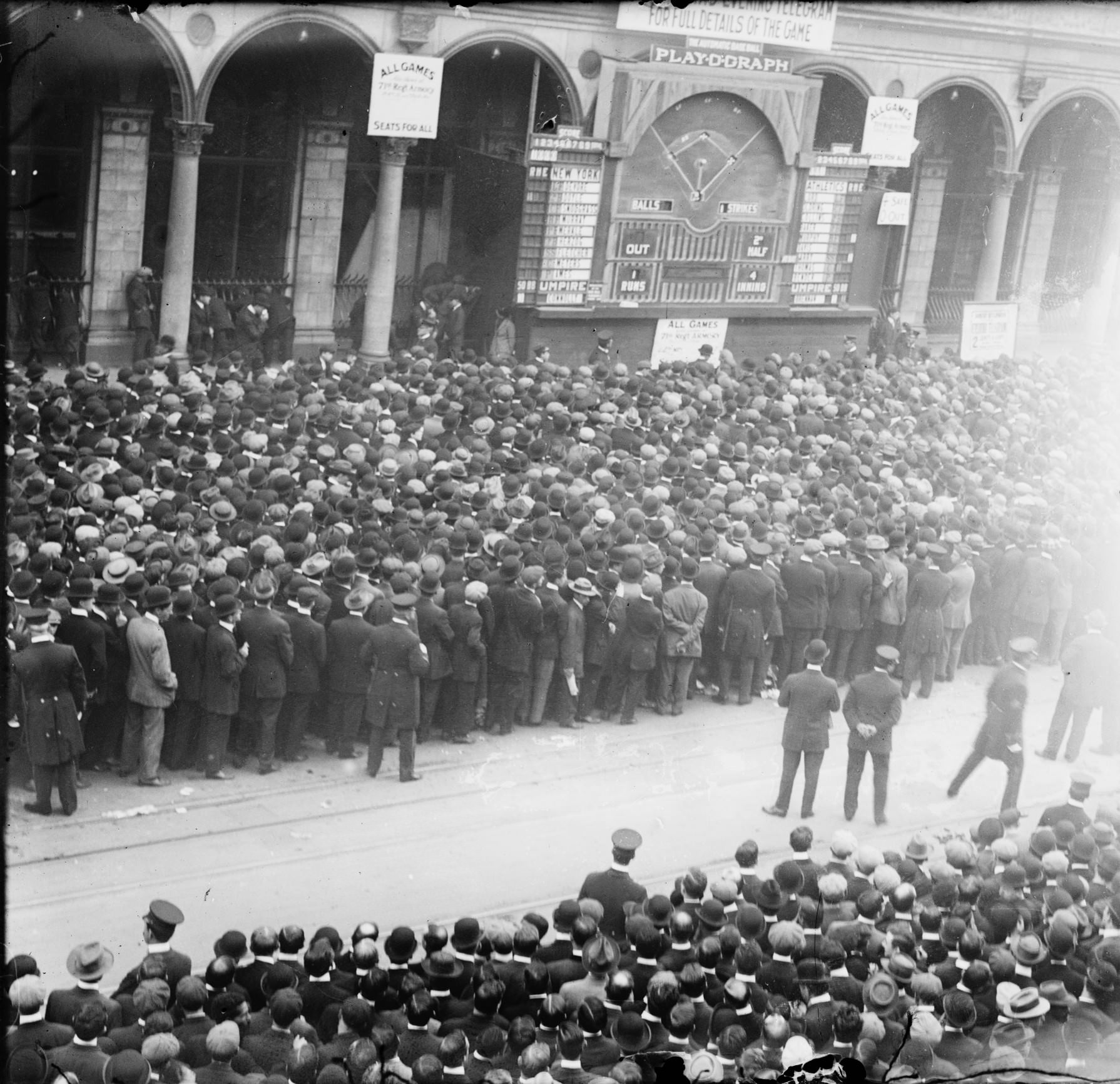
Outside The New York Herald Building, a dense sea of hats and dark coats presses toward a towering Play-O-Graph as the 1911 World Series unfolds one update at a time. The crowd stands shoulder to shoulder, craning for any hint of the latest tally, while the building’s arches frame the improvised theater of sport and news. It’s a striking reminder that baseball fandom didn’t require a ticket—only proximity to a scoreboard and the patience to wait for the next change.
The Play-O-Graph itself reads like an early form of live coverage, translating distant action into visible numbers for “balls,” “strikes,” and “runs,” with separate columns tracking the competing sides. Police and onlookers hold the street’s edge as the audience spills across the sidewalk, turning midtown pavement into a communal grandstand. In an era before radio broadcasts were universal and long before television, newspapers didn’t just report the game—they staged it in public.
What lingers is the mood of collective suspense: hundreds of strangers momentarily stitched together by innings, rumors, and the small drama of a shifting score. For anyone searching for vintage baseball photos, early 20th-century New York street scenes, or the history of sports media, this moment captures how the World Series became a mass event far beyond the ballpark. The Herald’s Play-O-Graph stands here as a landmark in the story of real-time reporting and the enduring hunger to follow the game as it happens.