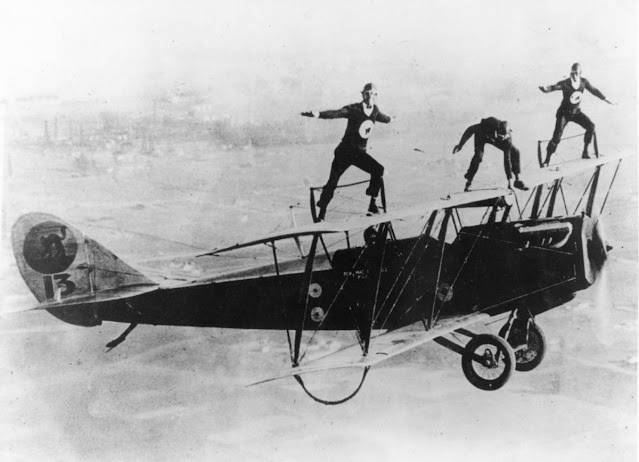
High above the ground, stunt pilot Bon MacDougall holds a steady course while three members of the Flying Black Cats—“Spider” Matlock, Al Johnson, and “Fronty” Nichols—balance on the upper wing with arms outstretched. Their dark outfits and bold chest emblems read clearly even at a distance, turning the biplane into a moving stage where every step has consequence. The scene captures the raw drama of early air shows, when spectacle depended as much on nerve and choreography as on the aircraft itself.
Beneath the airplane’s nose, a smoke generator adds a theatrical flourish, suggesting how these performers painted the sky to guide the crowd’s eyes and heighten the sense of speed. The biplane’s struts and wires form a lattice around the wingwalkers, emphasizing how little separation existed between performer and open air. In an era before modern safety systems, aviation stunts like this were equal parts entertainment and experiment, proving what pilots and machines could endure.
Few images sum up 1920s daredevil culture so vividly: a single aircraft, a composed pilot, and wing-walkers treating altitude like a dance floor. For readers interested in early aviation history, barnstorming, and the Flying Black Cats, this photograph offers a crisp reminder of how airshow legends were made. It’s not just a record of a performance—it’s a portrait of risk, showmanship, and the public’s fascination with flight.