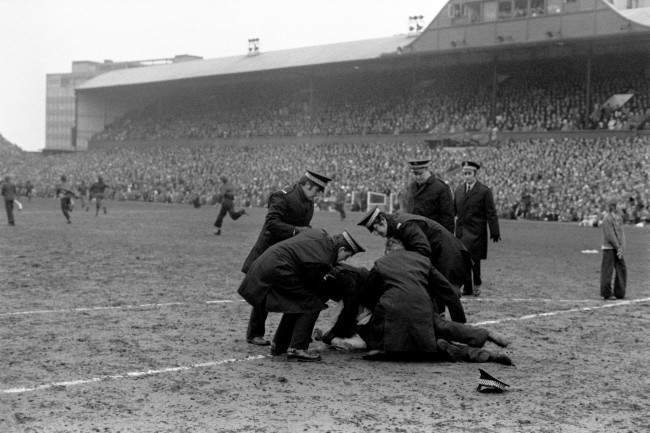
Across the muddy edge of a packed football ground, a knot of uniformed officers leans in to restrain someone on the turf while the terraces behind them heave with spectators. The contrast is jarring: a sea of supporters pressed shoulder to shoulder, and in the foreground a sudden, intimate struggle that pulls the match-day spectacle into something darker. Details like the caps, heavy coats, and churned-up pitch underline how quickly ordinary policing could be swallowed by crowd pressure in Britain’s football era of disorder.
Moments like this help explain why the 1970s through the 1990s became synonymous with British football hooliganism, confrontations, and stadium unrest. The photograph hints at the uneasy choreography between fans, stewards, and police—containment on the field, anxiety in the stands, and the constant fear that excitement could tip into violence. Even without a visible scoreboard or clear signage, the scene reads as a familiar chapter in social history: sport as both communal ritual and flashpoint.
For readers drawn to vintage football photos, this post looks beyond nostalgia to the lived reality of match days when control often felt precarious. These archival images spotlight crowd behaviour, policing tactics, and the tense atmosphere that shaped debates about safety, segregation, and the changing culture of the game. It’s a stark reminder that the story of British football isn’t only about goals and glory, but also about the conflicts that forced the sport—and its institutions—to reckon with itself.