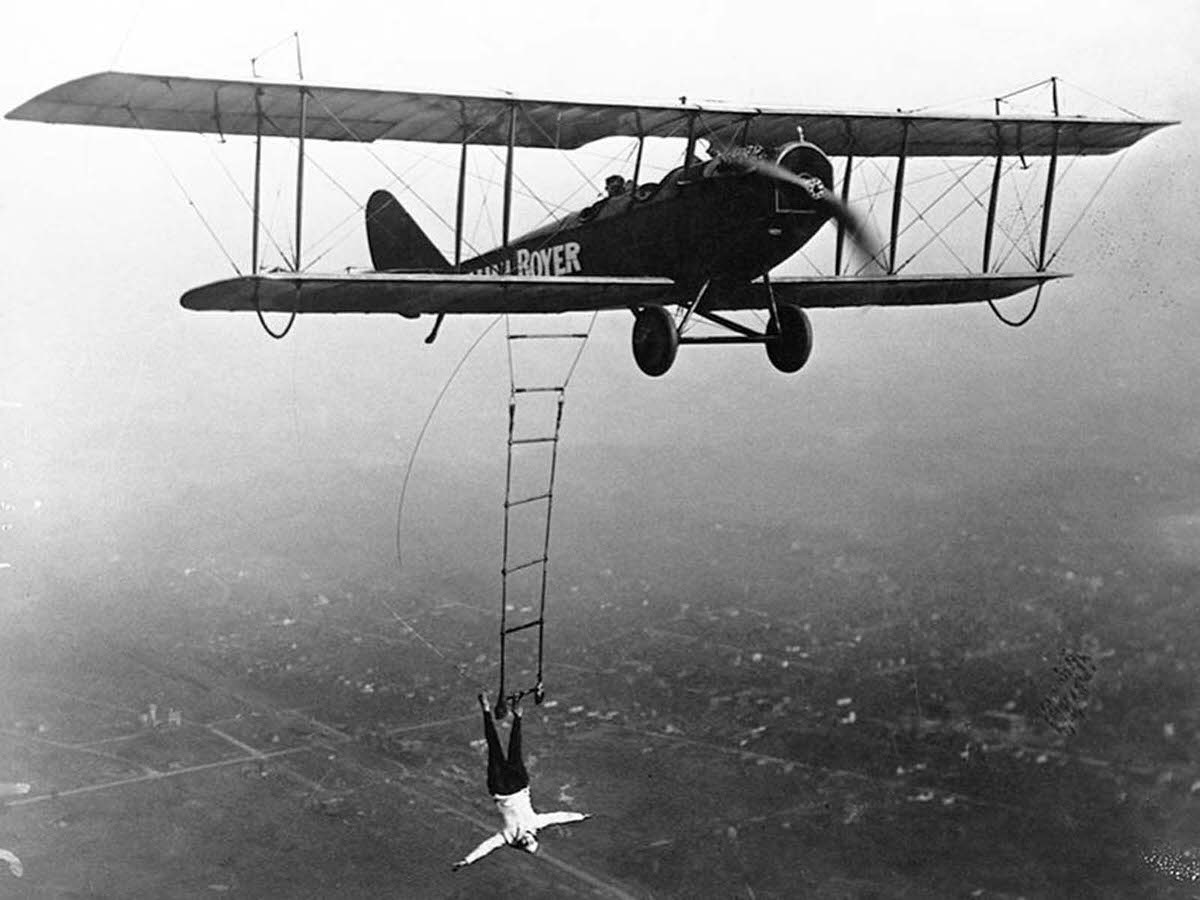
High above the ground, a biplane slices through open sky while Lillian Boyer dangles below, gripping the right wing boom with her right hand as if gravity were negotiable. The aircraft’s struts and wires form a rigid lattice overhead, and a rope ladder trails down into empty space, emphasizing both the engineering of early aviation and the sheer exposure of the stunt. Even at a glance, the scene carries the unmistakable tension of speed, wind, and altitude.
Wing walking in the 1920s belonged to a rough-and-ready era of airshows, when pilots and performers turned fragile-looking machines into flying stages. Boyer’s pose—part acrobatics, part endurance test—speaks to the athleticism required to work outside a moving aircraft, where every shift of weight mattered. The blurred propeller and the distant landscape below underscore that this isn’t a studio trick, but a lived moment from the daredevil culture of early flight.
For readers drawn to aviation history, sports spectacle, or women who defied expectations in public view, this photograph offers an unforgettable window into the period’s appetite for risk and wonder. The name “BOYER” painted on the fuselage doubles as a signature, a reminder that performers built reputations the way barnstormers built crowds—one dramatic pass at a time. As a historical image, it captures the romance and danger of the early days of aviation in a single, vertigo-inducing frame.