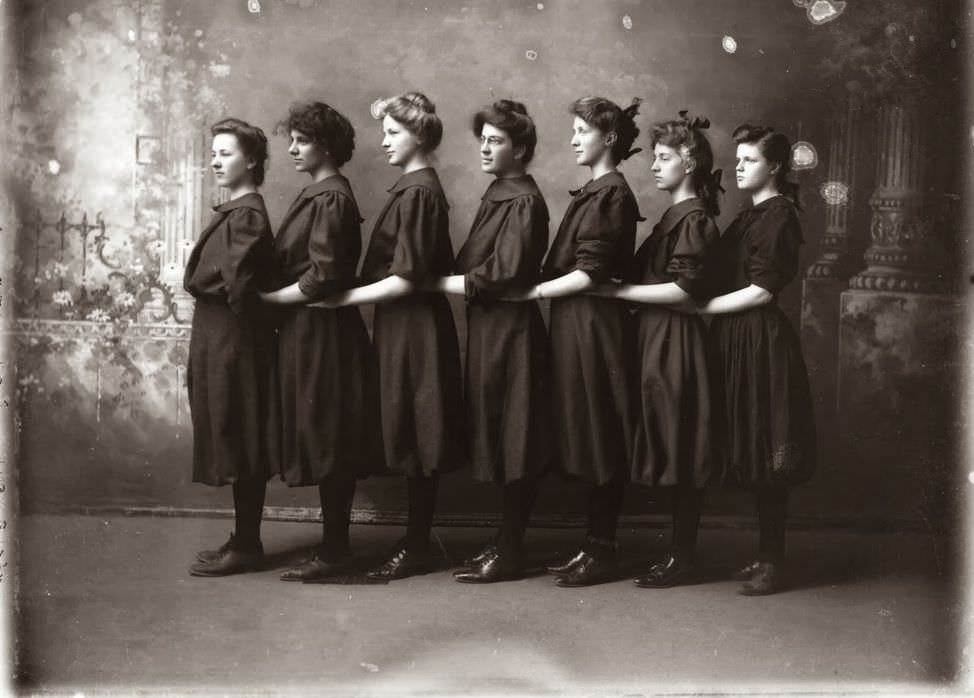
A line of seven young women stands shoulder to shoulder in a studio setting, posed with an almost choreographed precision that feels both playful and formal. Their matching dark uniforms—high collars, long sleeves, and calf-length skirts—signal an era when women’s basketball was still negotiating what “appropriate” athletic dress looked like. Each figure turns in profile, hands resting at the waist of the teammate ahead, creating a quiet sense of unity that reads like a team portrait and a statement of belonging.
Labeled as the Miami University Liberal Arts College Women’s Basketball Team in 1903, the photograph offers a glimpse into early collegiate sports culture and the growing presence of women on campus playing organized games. The careful posture and composed expressions suggest the seriousness with which these students approached competition, even when the wider world often treated women’s athletics as novelty. Small details—tidy hairstyles, sturdy shoes, and the uniformity of their stance—hint at training, discipline, and the pride of representing a school community.
For anyone researching Miami University history, women’s sports, or the evolution of basketball in the early twentieth century, this image is a rich primary source. The backdrop and studio lighting place it firmly in the conventions of turn-of-the-century portrait photography, where athletic identity had to be translated into a setting more often used for family or graduation portraits. Seen today, the team’s orderly lineup feels like an early chapter in the long story of collegiate women’s basketball—one built on camaraderie, perseverance, and visibility.