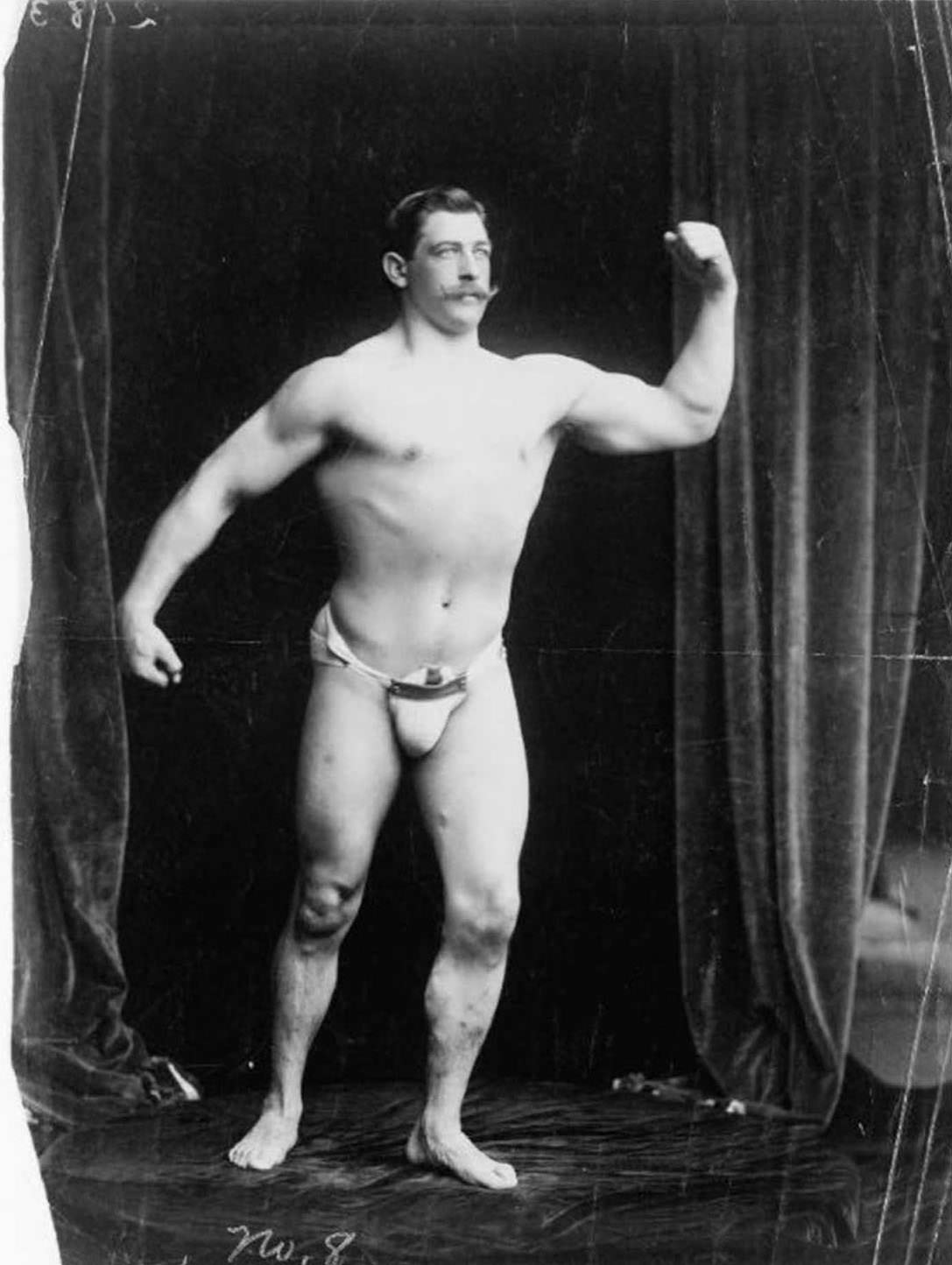
Under a heavy studio curtain, a mustachioed strongman stands barefoot and nearly bare, striking a classic flex that turns the human body into a statement of power. The pose is deliberate—one arm raised, the other set to balance the line of his shoulders and chest—while the soft, theatrical backdrop keeps all attention on muscle, posture, and presence. Small scuffs and creases in the print remind us this is an artifact as much as a portrait, handled, saved, and passed down from an era when “physical culture” was becoming a public fascination.
Around 1901, strength athletes were often marketed as marvels of modern vitality, bridging old-world feats of lifting with the newer idea of bodybuilding as display and discipline. Instead of action or competition, the camera favors presentation: controlled stance, confident gaze, and the careful symmetry of the body under studio lighting. It’s the kind of image that once appeared on cabinet cards and promotional materials, helping audiences imagine what training, diet, and willpower could supposedly achieve.
For readers interested in early bodybuilding history, this photograph sits at the crossroads of sport, entertainment, and popular health movements of the early 1900s. The minimal setting and uncluttered composition make it an unusually direct document of how strength was staged for the public—part athlete, part performer, part ideal. “Strongman, circa 1901” also works as a vivid reminder that today’s fitness culture has deep roots, shaped as much by spectacle and photography as by the gym.