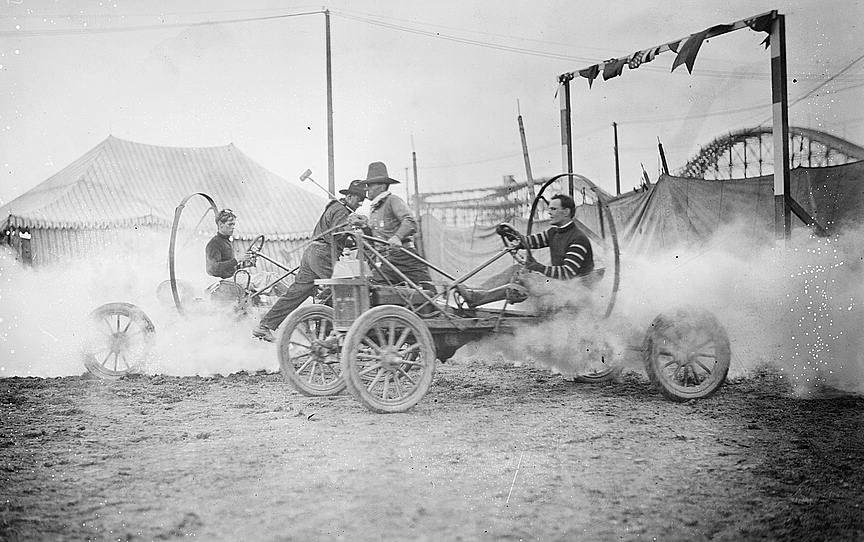
Coney Island’s reputation for spectacle finds a perfect match in auto polo, a short-lived motorsport craze that swapped horses for stripped-down cars and turned polo into a roaring sideshow. In the foreground, an open vehicle skids across a rough dirt field, its spoked wheels blurred and a cloud of dust curling up behind it. A player leans out with a mallet in hand while the driver braces at the wheel, the pair balancing speed, steering, and the constant threat of a spill.
Behind the action, tents and fencing frame the improvised arena, and a hint of the amusement rides rises in the distance, tying the contest to the larger carnival atmosphere of the boardwalk. The cars themselves look lightly built and exposed, more like skeletal runabouts than today’s reinforced machines, which helps explain why auto polo became notorious for crashes and mechanical carnage. The scene feels less like a gentleman’s sport and more like a dare—part athletic contest, part mechanical stunt.
For readers exploring early 20th-century sports history, this photograph captures the moment when automobiles were new enough to be thrilling and unpredictable, and promoters eagerly repackaged traditional games for modern crowds. Auto polo at Coney Island speaks to an era that celebrated speed, noise, and novelty, even when the risks were obvious. It’s a vivid reminder that the path from horse-powered pastime to motorized entertainment was paved with experimentation, dust, and applause.