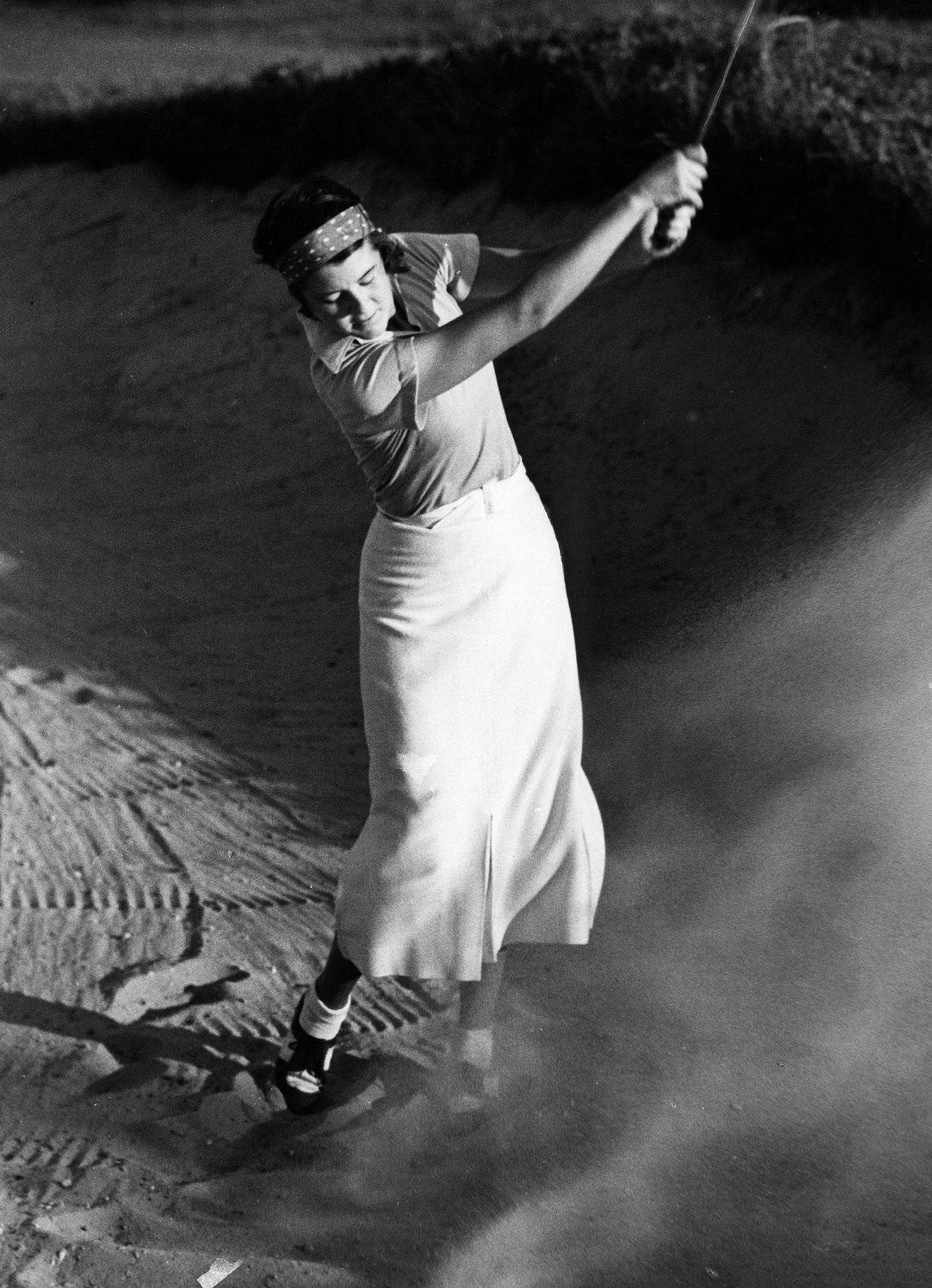
Caught at the top of her follow-through, Ursula von der Marwitz turns a bunker shot into a small burst of drama at Golf-Club Berlin-Wannsee, a scene dated to circa 1935. Sand rises in a pale cloud at her feet while the club arcs overhead, freezing the athletic geometry of the swing for the camera. The dark turf behind her and the bright spray in the foreground create a hint of motion even in stillness, a classic ingredient of compelling sports photography.
Fashion and function meet in her golf attire: a long, light skirt that moves with the pivot, a short-sleeved top, and a patterned headband keeping hair in place. The outfit speaks to an era when women’s sport balanced modern freedom with prevailing expectations of propriety, yet the posture tells its own story—focused, confident, and technically assured. Seen up close, details like the shaded face and planted feet emphasize the physical discipline that golf demands, especially from the sand.
For readers interested in women’s golf history in Germany, interwar leisure culture, or the evolution of athletic style, this photograph offers more than nostalgia. Golf-Club Berlin-Wannsee appears here not as a postcard setting but as a working course, complete with raked bunker texture and the gritty reality of a difficult lie. Whether you arrived via a search for Ursula von der Marwitz, Berlin golf heritage, or early 20th-century sports images, the moment invites a longer look at how women claimed space in the game—one decisive swing at a time.