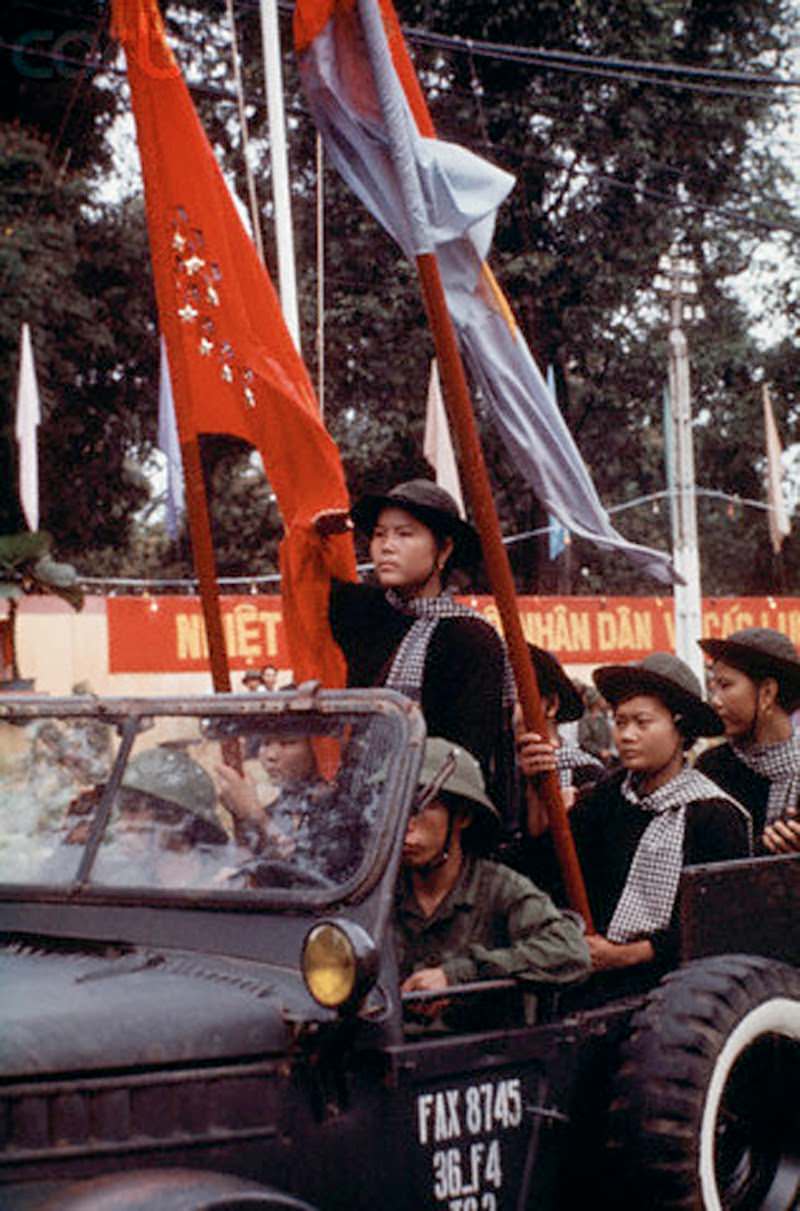
Red flags and banners rise above a moving jeep as female North Vietnamese troops enter Saigon, their faces set with a composed, purposeful calm. The driver sits low behind the windshield while one soldier stands upright, gripping a tall pole as fabric snaps in the air. In the tight framing, uniforms, headgear, and the vehicle’s worn metal surfaces do as much storytelling as the flags themselves—an urban arrival rendered in color and motion.
Women’s participation in the Vietnam War often gets reduced to slogans or sidelined in popular memory, yet scenes like this place them unmistakably in the foreground of military and political change. The troop’s presence in a street setting, surrounded by signs and bystanders, hints at the way warfare and everyday city life collided during the final push into the South. The expressions here are not celebratory caricatures but a study in discipline and transition, suggesting both victory and the weight of what comes after.
For readers searching Vietnam War history, the fall of Saigon, or the role of women soldiers in Vietnam, this photograph offers a vivid entry point. It preserves the texture of the moment—flags, uniforms, crowd, and vehicle—without needing captions to convey its historical gravity. Look closely and the image becomes less about a single jeep and more about a turning of the page, as power changes hands in a city on the brink of a new era.