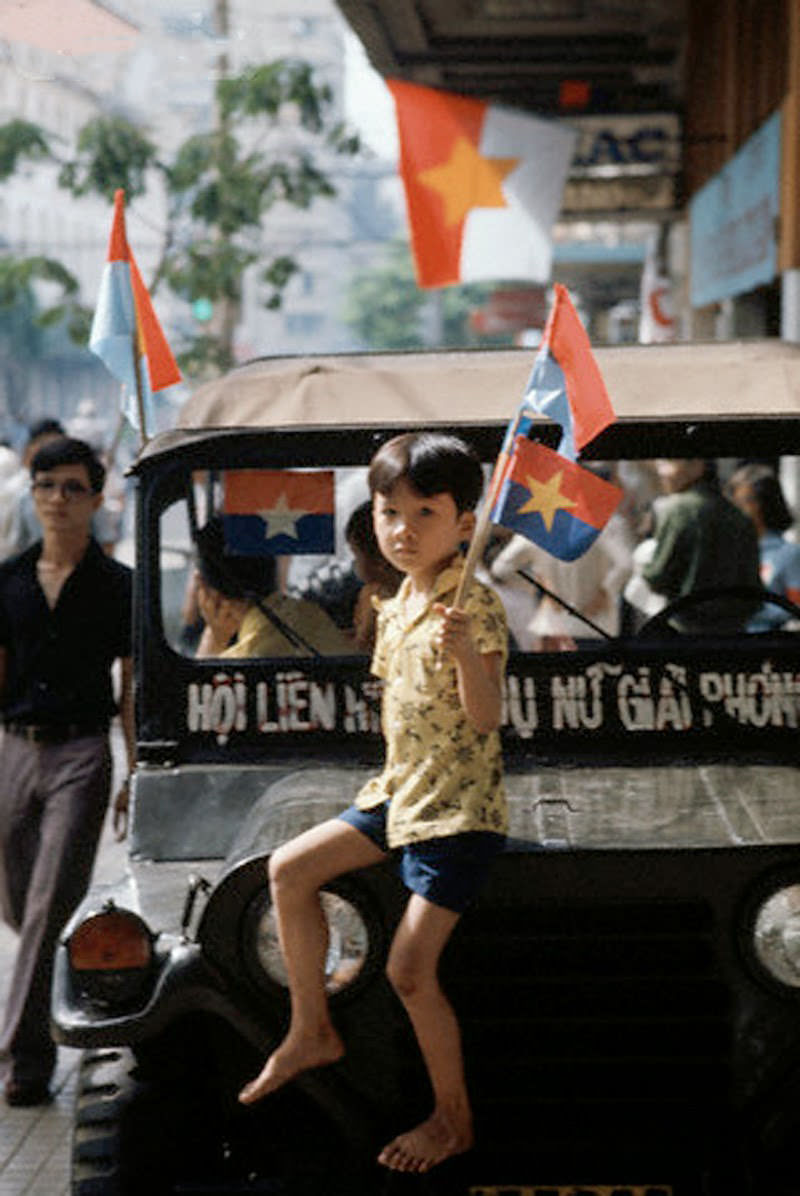
Barefoot and steady on the front of a jeep, a young boy raises a small transitional flag associated with South Vietnam’s brief interim period in 1975, his gaze fixed forward as if trying to understand the tide moving around him. The street behind him is crowded and hazy, with additional flags fluttering above the vehicle and along the roadside, turning an ordinary city block into a moving display of power, uncertainty, and public ritual. In the middle of the Fall of Saigon, that child-sized gesture becomes a striking focal point amid the churn of the Vietnam War’s closing moments.
Color gives the scene its sting: the bright red-and-blue pennants with a yellow star stand out against the jeep’s dark metal and the muted tones of the passing crowd. Letters painted across the vehicle’s front hint at organized civic or political presence, while the boy’s casual shirt and shorts underscore how quickly history presses into daily life. Nothing here reads like a formal parade; it feels improvised, intimate, and tense, as if the city itself is holding its breath.
For readers searching for Vietnam War history, the Fall of Saigon, or the symbolism of flags during reunification, this photograph offers a human-scale entry into a monumental political transition. The “transitional flag” referenced in the title—used for only a short span in mid-1975—anchors the image to a narrow window when old identities were collapsing and new ones were being enforced. Seen through the boy’s posture and the jeep’s slow presence, the moment suggests how abruptly a nation’s future can arrive, and how ordinary people are carried into it.