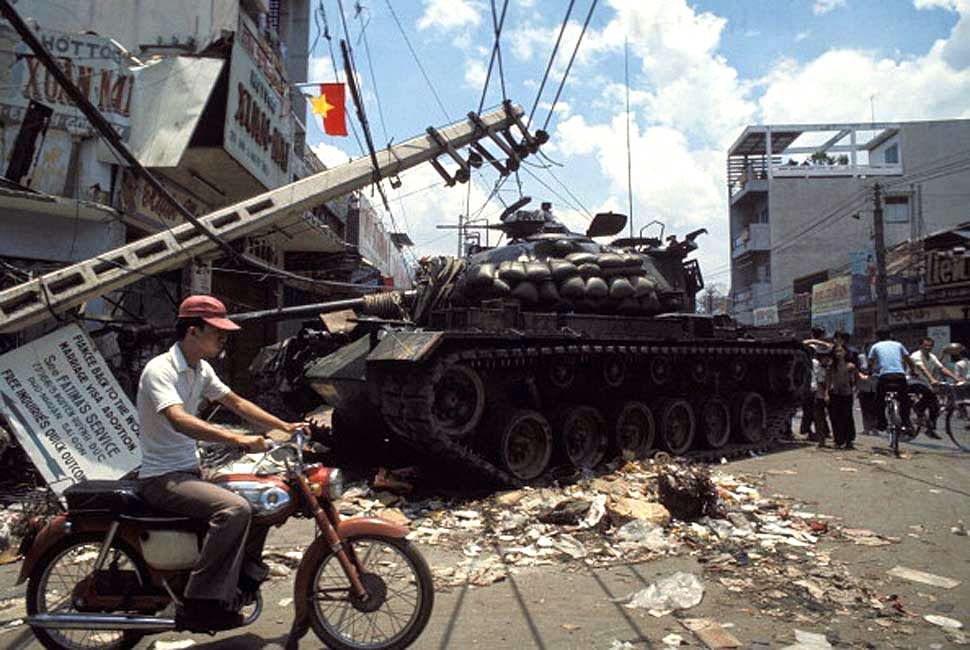
A heavy tank sits wedged in the middle of a Saigon street, its dark mass contrasting with the bright sky and the jumble of shopfronts and signage around it. Overhead, power lines and a collapsed utility structure hang at awkward angles, suggesting a city’s infrastructure strained by the last convulsions of war. Litter and debris spill across the roadway, turning an ordinary commercial block into a scene of abrupt disruption during the Fall of Saigon in April 1975.
In the foreground, everyday life refuses to disappear: a motorcyclist rides past the armored vehicle, while small groups of people gather near the curb, watching and waiting. The photograph’s tension lies in that collision between routine movement and military presence, between civilians navigating familiar streets and the unmistakable machinery of conquest. Details like the crowded cables, storefront awnings, and street-level clutter root the moment in urban Vietnam rather than an abstract battlefield.
For readers searching the Vietnam War’s closing chapter, this image offers a grounded view of what “the end” looked like on the street—noise, confusion, spectatorship, and sudden symbols of control. Rather than focusing on leaders or maps, it lingers on the texture of Saigon itself: commerce interrupted, traffic rerouted, and a city reshaped in real time. The result is an unforgettable historical photo of the Fall of Saigon, capturing how quickly a capital’s daily rhythm can be overtaken by history.