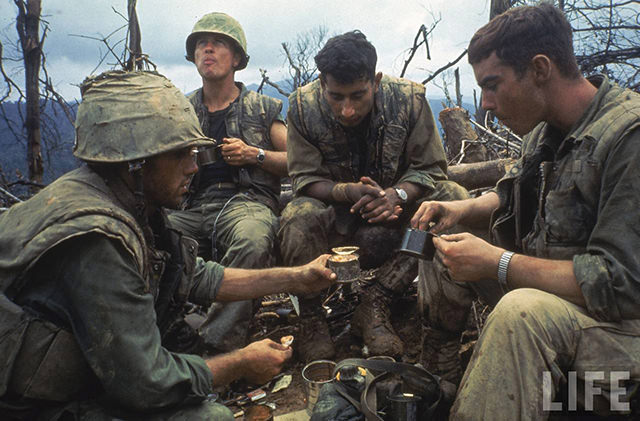
Mud-stained utilities and dented helmets tell the story before a single word is read: a small group of U.S. Marines has dropped into a shallow scrape of earth to eat rations during a brief lull near the DMZ in the Vietnam War. The men hunch close, passing opened cans and cups between them, their hands busy with simple tasks that momentarily replace the demands of combat. Around them, the landscape looks battered and bare, with broken branches and churned ground hinting at the violence that has recently swept through.
Even in a pause, the tension lingers in their posture and expressions, as if they’re listening for what might come next. One Marine focuses on prying at a container while another steadies a cup, and the shared meal becomes an improvised ritual of endurance and teamwork. Details like wristwatches, canteen cups, and field gear scattered at their knees anchor the scene in the everyday realities of Vietnam War service—hot food, if it can be called that, and a few minutes to breathe.
Scenes like this are invaluable for readers searching for authentic Vietnam War photographs, U.S. Marine Corps history, and life near the Demilitarized Zone. Rather than staged heroics, the frame preserves a quieter truth: war is also waiting, eating, and conserving strength in a devastated environment. For anyone exploring the conflict’s human dimension, this moment of rations and silence offers a stark, intimate window into what “lull in the fighting” really meant.