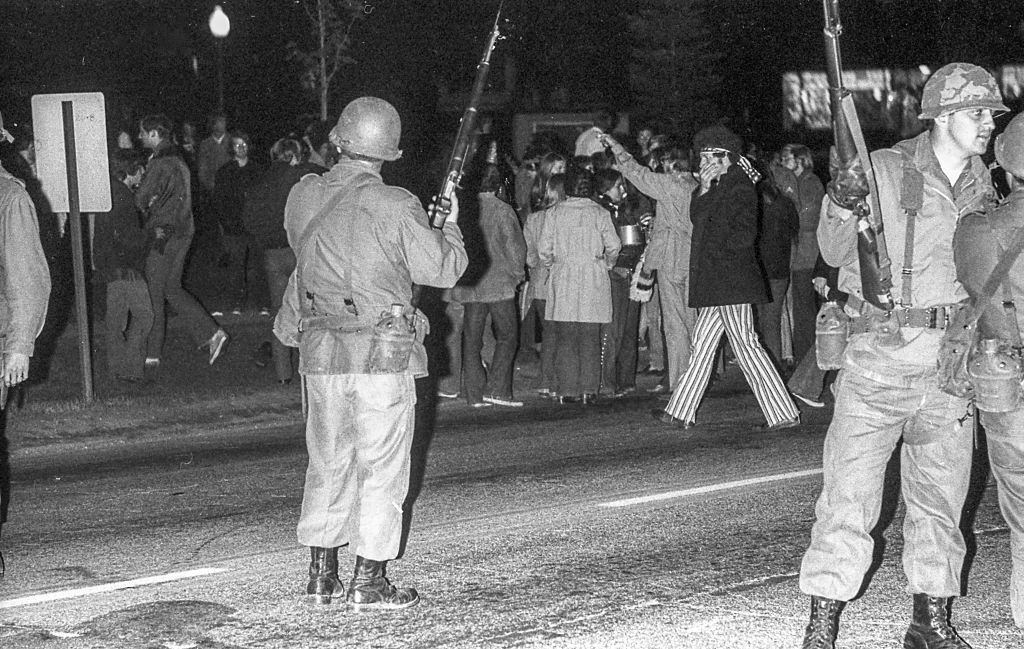
Streetlights and camera flash catch the hard outlines of helmets and rifles as Ohio National Guardsmen hold position in Kent, Ohio, on the night of May 3, 1970. The soldiers form a tense foreground, their gear and stance suggesting readiness rather than ceremony, while a crowd gathers behind them at the edge of the roadway. Faces blur into the darkness, but the mood is unmistakable: watchful, crowded, and uneasy.
In the background, civilians move in clusters, some pausing to look, others walking through the scene as if caught between curiosity and caution. A figure in striped pants strides past raised arms and turned heads, underscoring how quickly ordinary campus-town life could be overtaken by confrontation. The visual contrast—armed troops in the front, unarmed onlookers in the rear—turns the street into a boundary line.
Set against the Vietnam War era’s widespread protests, this nighttime view resonates far beyond its immediate moment, evoking the pressures that built across American communities in 1970. For readers searching Kent State, Ohio National Guard, May 3, 1970, or Vietnam War protest history, the photograph offers a stark reminder of how public dissent and state power met face-to-face after dark. It preserves not just what happened, but what it felt like to stand on a road where the night itself seems charged with expectation.