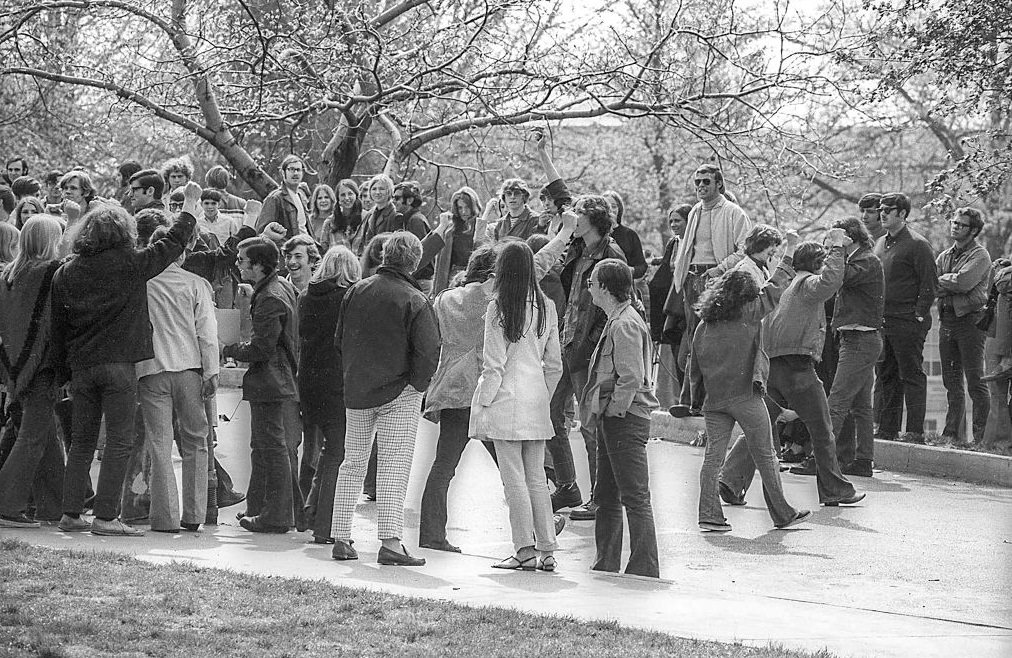
Along a campus road at Kent State University, a crowd of students gathers in a loose ring beneath bare spring branches, their bodies angled toward the center as if listening, arguing, or chanting. Several arms rise above the heads—some clenched in fists, others gesturing mid-sentence—while classmates on the edges watch with folded arms or hands in pockets. The scene feels both ordinary and charged: everyday jackets, bell-bottoms, and backpacks set against a moment when public space becomes political space.
May 3, 1970 sits in the turbulent context of Vietnam War–era activism, when antiwar protests spread across American colleges and universities. What stands out here is the mix of expressions—determined, skeptical, curious—suggesting a campus community negotiating purpose and pressure in real time. Rather than a staged tableau, the photograph reads like a slice of movement: people shifting positions, turning to respond, joining or drifting away, the road functioning as an impromptu meeting ground.
For readers searching Kent State history, student protest photography, or Vietnam War dissent, this image offers a grounded view of how activism looked on the ground—crowded, conversational, and communal. It invites close looking at the small details: who raises a hand, who hangs back, how groups form and dissolve around a shared cause. Seen today, the photo serves as a reminder that pivotal events are built from moments like this, when students bring their convictions into the open and a campus becomes a crossroads of national debate.