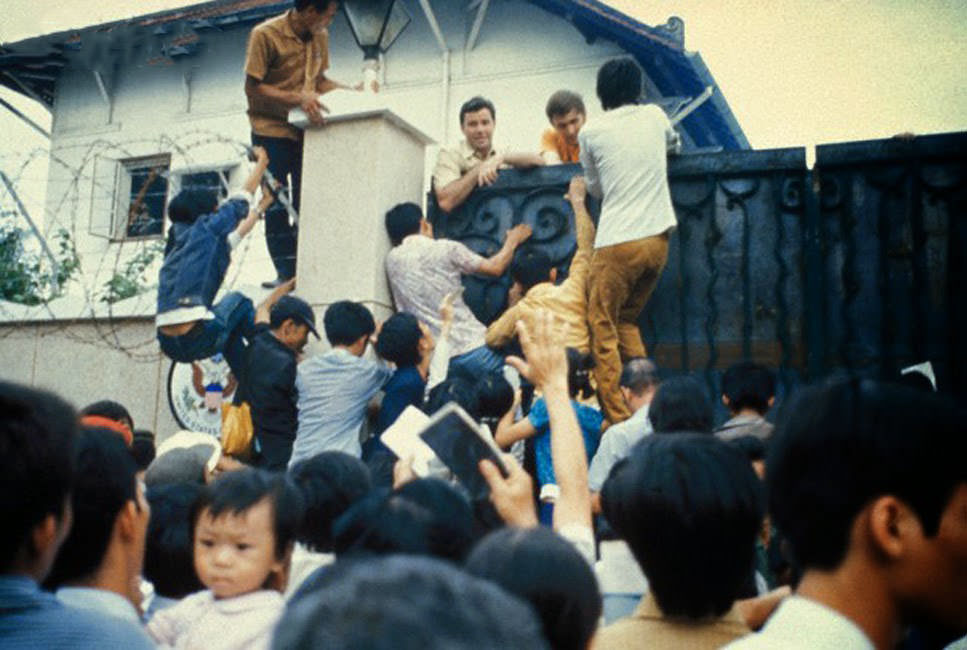
Near the top of a wrought-iron embassy gate, hands clutch at bars and shoulders as a knot of civilians tries to pull one another upward, turning the entrance into a human ladder. Below, a dense crowd presses forward—faces blurred by motion and urgency—while a small child in the foreground stares out with a stillness that cuts through the chaos. On the other side of the barrier, men lean down from behind the wall, caught between helping and holding a line that was never meant to bear this kind of weight.
The scene distills the final, frantic hours of the Vietnam War in Saigon, when rumors, fear, and the thunder of an advancing army pushed thousands toward any doorway that hinted at rescue. An embassy—normally a place of paperwork, protocol, and guarded distance—becomes a last refuge, its walls suddenly measuring the difference between safety and surrender. In the crush of bodies, documents and belongings are raised overhead, as if proof of identity might open a gate that is closing in real time.
What makes the photograph endure is its raw choreography: desperation below, uncertainty above, and the rigid architecture of diplomacy trying to contain a collapsing world. The American Embassy in Saigon has come to symbolize the war’s end not through speeches, but through moments like this—improvised, crowded, and profoundly human. For readers searching Vietnam War history, the Fall of Saigon, or the evacuation of Saigon, this image offers an unfiltered look at how geopolitics is finally experienced: one grip on the wall at a time.