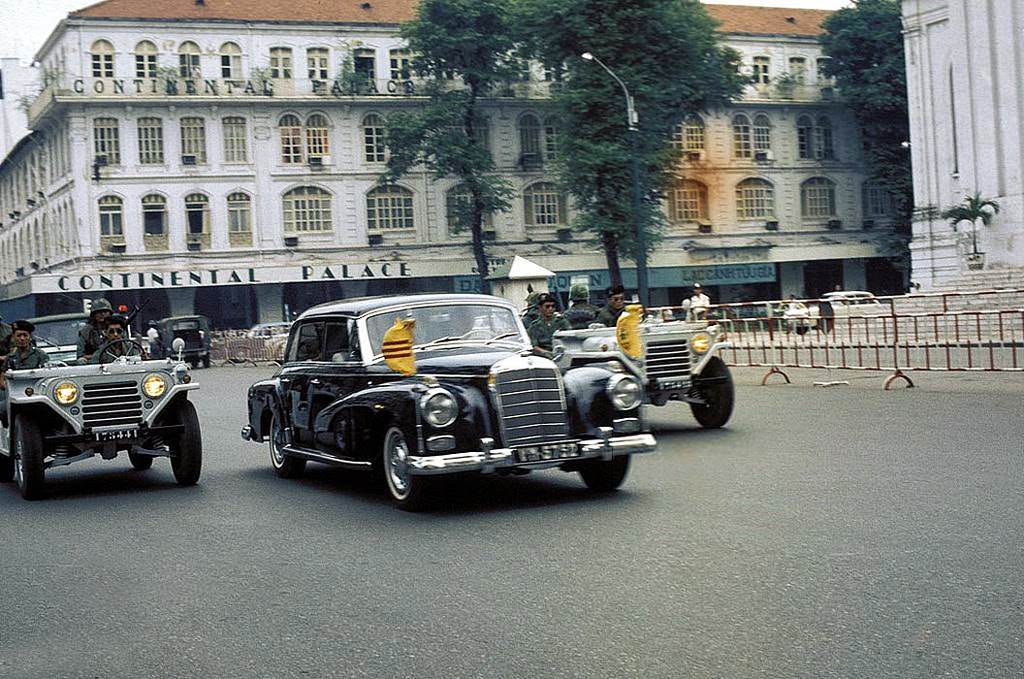
Traffic has been cleared for a tight motorcade sweeping past the Continental Palace, its colonial façade looming behind temporary barricades and roadside trees. At the center, a dark Mercedes sedan rides low and polished, bracketed by open jeeps carrying armed men who scan the street with practiced focus. The scene feels both ceremonial and tense—an official passage through a city whose everyday rhythm has been interrupted.
Taken in Saigon during the final months of the Vietnam War, the photograph hints at how power moved in public when the state was under immense pressure. The juxtaposition is striking: elegant architecture and neat streetlines on one side, security details and controlled space on the other. Even without hearing the engines or the crowd, the image conveys urgency, surveillance, and the fragile theater of authority.
In the context of the Fall of Saigon in April 1975 and the title’s reference to President Thieu, this moment reads as a snapshot of leadership in retreat from stability toward uncertainty. For readers exploring South Vietnam’s last days, the motorcade, the guarded perimeter, and the iconic city backdrop offer vivid visual evidence of a capital bracing for collapse. It’s a compelling historical photo for anyone researching Saigon 1975, the end of the Vietnam War, and the atmosphere surrounding South Vietnam’s highest offices.