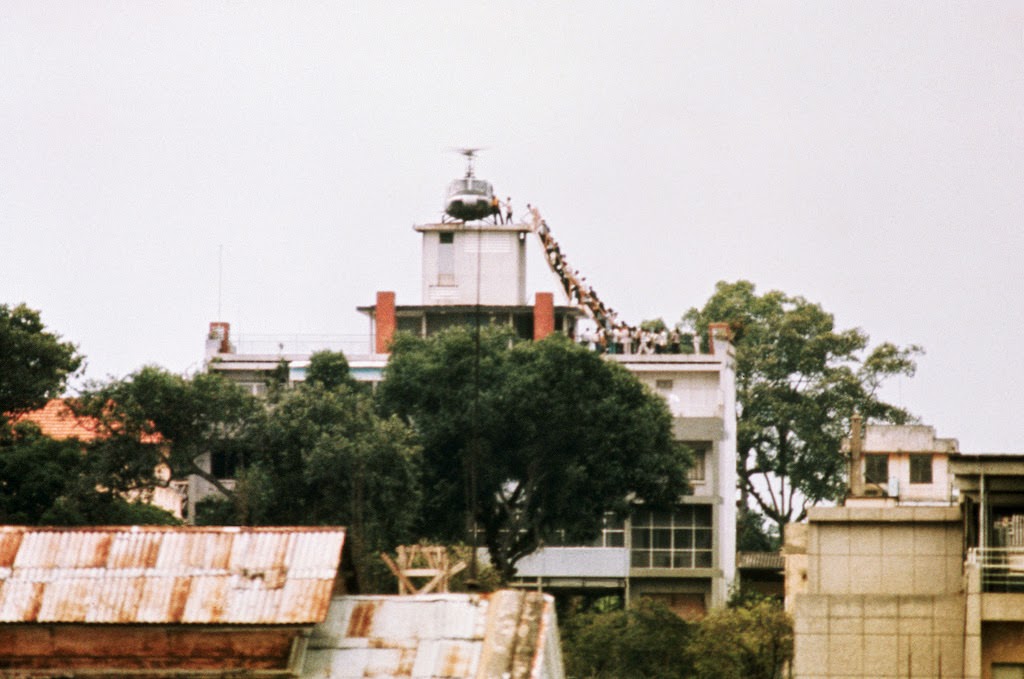
High above Saigon’s streets, a small rooftop becomes an impromptu lifeline as an Air America helicopter waits with its rotors poised, and a line of evacuees inches toward the landing point. The title identifies the scene as 22 Gia Long Street, roughly a half mile from the U.S. Embassy, on 29 April 1975—one of the last, most frantic days of the Vietnam War. From a distance, the figures form a tense procession, their urgency conveyed by how tightly they bunch along the roofline and stairway.
Air America, the airline long associated with U.S. intelligence operations in Southeast Asia, appears here in its most remembered role: ferrying people out as the city’s situation collapsed. The post title notes a CIA employee—probably O.B. Harnage—helping Vietnamese evacuees board, a detail that underscores how ad hoc and personal the evacuation could become despite its geopolitical scale. Trees and neighboring buildings frame the rooftop, highlighting how rescue unfolded in ordinary urban spaces rather than at formal airfields.
Few images summarize the fall of Saigon as powerfully as a helicopter perched atop a building, and this photograph points straight to the improvisation and peril that defined those final hours. The elevated perspective emphasizes separation—between those who reached the roof and those still below—while the helicopter suggests the narrow window of time available. For readers searching Vietnam War history, Operation Frequent Wind, Air America helicopters, or the final days of Saigon, this scene offers a stark, human-sized view of a moment that changed countless lives.