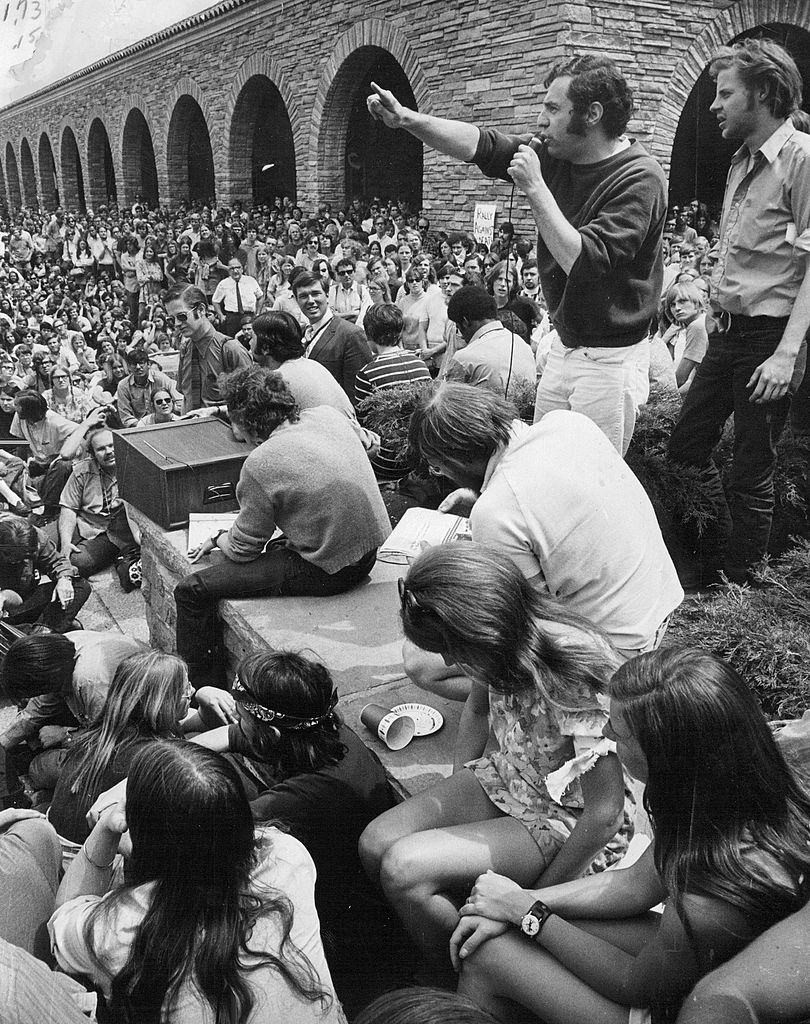
A law professor stands above a dense crowd, microphone in hand and arm outstretched, urging students toward collective action in the wake of national tragedy. The title identifies him as Robert Fitter of CU Law School, speaking on May 5, 1970—an immediate response to the killing of four students that intensified campus unrest during the Vietnam War era. Faces turn upward from every angle, forming a living amphitheater of attention, grief, and resolve.
Behind the speakers, a long line of stone arches frames the gathering, emphasizing how public space on campus became a forum for protest and mourning. Students sit shoulder to shoulder on steps and ledges, some perched close to the front while others stand packed into the background, creating a sense of swelling momentum. The scene captures the texture of a memorial protest: not only speeches, but the shared silence, murmurs, and watchfulness that follow when a community is trying to decide what comes next.
Moments like this help explain why the early 1970s remain pivotal in the history of student activism and free expression in higher education. By focusing on a call to strike, the photo points to the strategies students and faculty used to confront war, state violence, and the limits of institutional authority. For readers searching CU student protest history, Vietnam War demonstrations, or the campus response to the killing of four students, this image offers a grounded, human-scale window into an era when public dissent reshaped American universities.