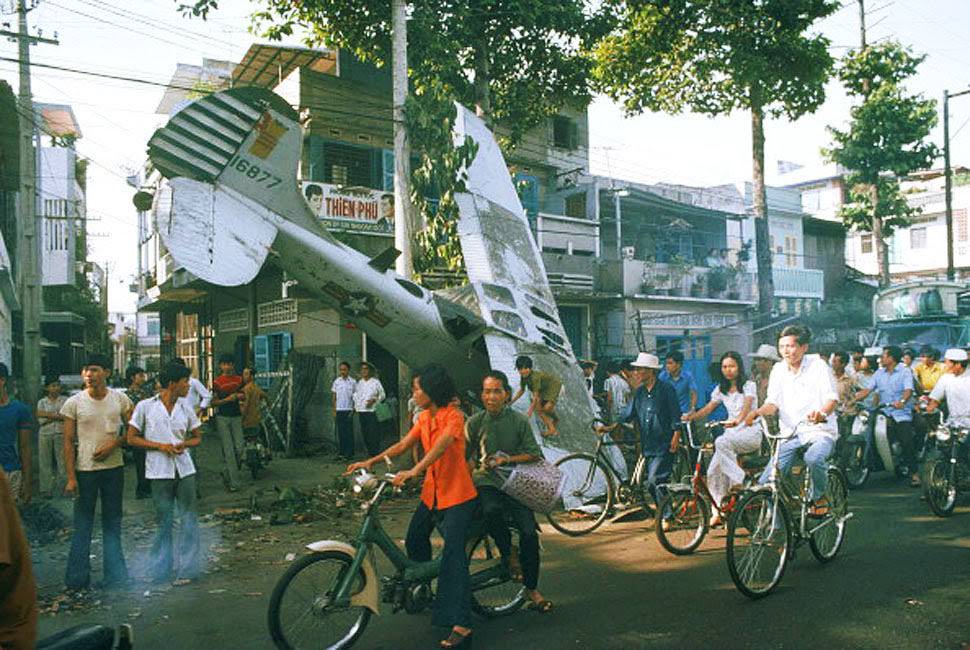
A neighborhood street in wartime Saigon becomes an impromptu crash site, where the tail and torn fuselage of a small South Vietnamese liaison aircraft jut up at an impossible angle between shopfronts and power lines. Painted markings and a visible tail number hint at its military role, yet the scene is unmistakably civilian: bicycles roll past, pedestrians gather at the curb, and a bus waits in the background as if the city is trying to keep moving around the wreckage. The title’s suggestion of an attempted escape adds a charged context to the twisted metal and scattered debris.
Daily life and sudden catastrophe share the same frame here, a hallmark of Vietnam War photography that conveys disruption without needing staged drama. Faces turn toward the damaged plane with a mix of caution and curiosity, while the street’s signage and dense architecture underline how close the conflict pressed into ordinary neighborhoods. Even in color, the image feels gritty—dust on the road, shadows under trees, and the harsh geometry of broken wings against balconies and cables.
For readers searching Vietnam War history, Saigon imagery, or South Vietnamese aviation, this photograph offers a stark reminder that the air war did not always unfold over jungles or distant airfields. The aircraft’s likely fuel load, implied in the post title, makes the quiet aftermath more unsettling, as onlookers stand within reach of what could have been a far worse explosion. Preserved in a single moment, it documents not only a crash but the tense, lived reality of a city where escape and survival could collide on an ordinary street.