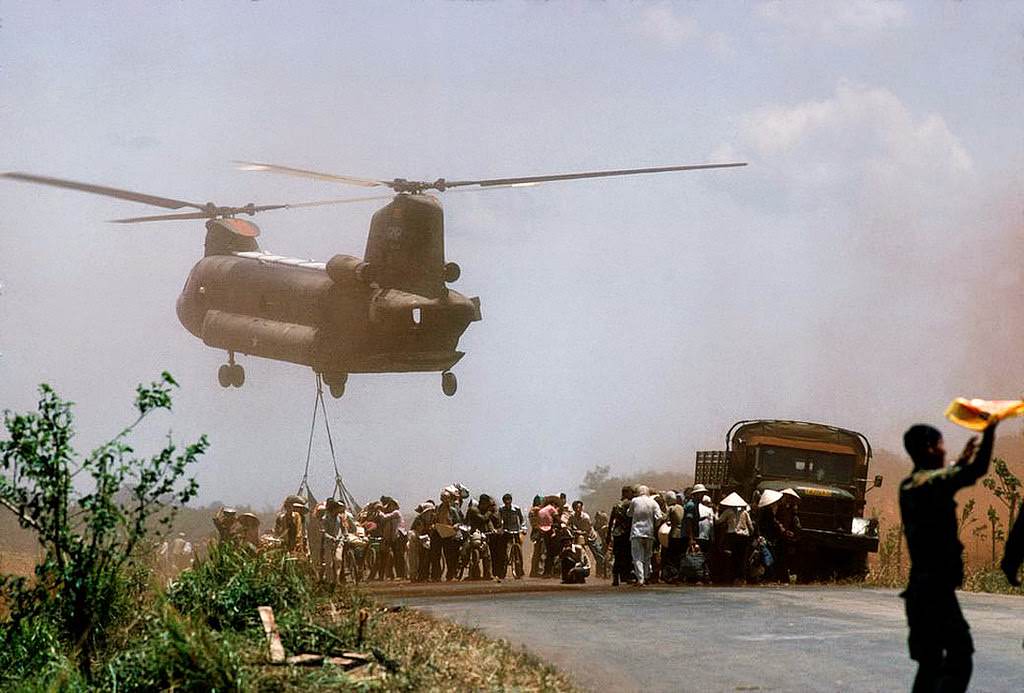
Rotor wash kicks up dust over a rural road as a large twin-rotor helicopter hovers low, its sling line dangling beneath the fuselage. Below, a dense crowd presses together—families and individuals clutching bundles, some wearing conical hats—while an overloaded truck idles nearby, ready to move or already abandoned in the chaos. Off to the side, a figure raises an arm as if signaling, a small gesture swallowed by the noise and urgency of evacuation.
The title, “Refugees during the last days of the Vietnam War,” frames the scene as more than a dramatic military moment; it is a portrait of displacement at speed. The helicopter dominates the sky, but the eye keeps returning to the people on the ground—uncertain where to stand, what to carry, and whether there will be room when the aircraft lifts again. In a single frame, the familiar themes of the Vietnam War—collapse, flight, and the scramble for safety—are distilled into a crowded roadside under a hazy, smoke-tinged horizon.
For readers searching Vietnam War history photos, evacuation images, or accounts of civilian refugees, this picture offers an immediate, unvarnished glimpse of the war’s endgame. It underscores how the final days were experienced not only in command centers and capitals, but in improvised gathering points like this one, where rumors and deadlines traveled faster than any vehicle. The dust, the waiting, and the hovering machine together evoke the fragile line between escape and being left behind.