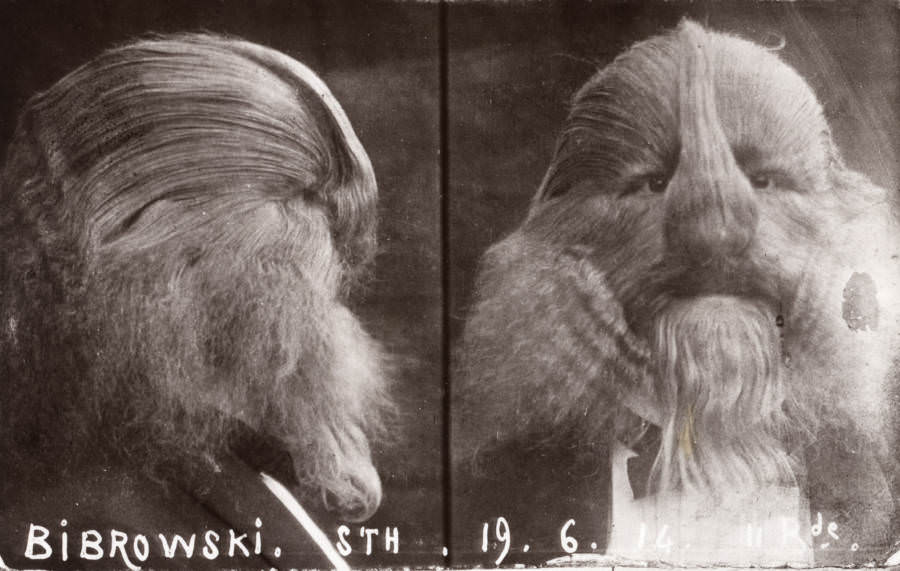
Stephan Bibrowski, billed to audiences as Lionel the “Lion-faced Man,” appears here in a stark 1914 portrait that reads like a sideshow poster stripped down to its essentials. The composition offers both a profile and a frontal view, emphasizing his long, flowing facial hair and the carefully arranged mane-like styling that became central to his stage identity. Handwritten markings along the bottom edge add to the archival feel, hinting at the way such images were cataloged, circulated, and repurposed for publicity.
Seen up close, the photograph is as much about presentation as it is about appearance: the studio lighting picks out texture in hair and skin, while the plain background keeps the viewer’s attention fixed on Bibrowski’s face. The side view highlights the dramatic silhouette, and the frontal view invites direct eye contact—an intentional contrast that turns curiosity into confrontation. Details like his formal collar and composed posture suggest a deliberate effort to project dignity within a world that often marketed difference as spectacle.
For readers searching for early 20th-century circus and freak show history, this image captures the uneasy intersection of entertainment, medical curiosity, and personal agency. The nickname “Lion-faced Man” reflects the period’s sensational language, yet the photograph also preserves a human presence behind the billing—calm, controlled, and unmistakably aware of the camera. As a historical artifact, it prompts questions about how performers like Bibrowski navigated fame, exploitation, and identity in an era hungry for the extraordinary.