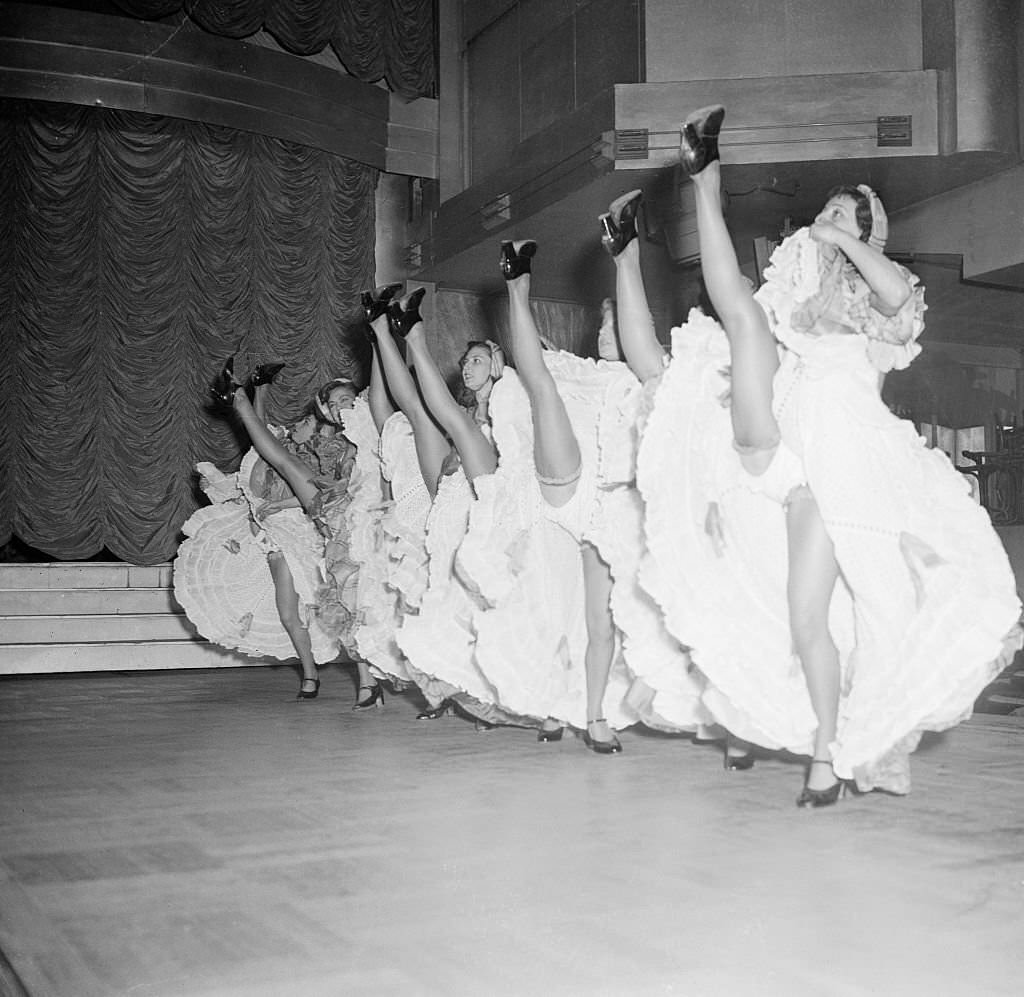
Across a bare rehearsal floor, a chorus line of cancan dancers lifts into synchronized, sky-high kicks, their dark shoes flashing against a sweep of white petticoats. Layered skirts billow like stage curtains in motion, creating a rhythmic pattern of ruffles and legs held at precise angles. Faces peek between the fabric and the line of raised knees, focused on timing, balance, and the exact height that turns a kick into a spectacle.
Behind them, heavy drapery and theater architecture hint at the Parisian music-hall world—an interior built for glamour, now serving as a workroom for repetition and sweat. The Tabarin name evokes the city’s long nightlife tradition, where popular entertainment blended dance, fashion, and a knowing wink at propriety. Here, away from the audience, the famous cancan reads less as carefree abandon and more as disciplined athleticism practiced in unison.
Reopenings in the performing arts are always acts of optimism, and this rehearsal scene captures that forward-facing energy in a single frozen beat. The costumes—frills, stockings, and voluminous underskirts—signal a classic cabaret silhouette while also showing how much the dance relies on costume choreography as much as steps. For anyone searching the history of the cancan, Paris cabaret, or music hall culture, the photograph preserves the moment when a night’s entertainment is still only a promise, built one kick at a time.